
Kohl’s (KSS) – Activist Pressure/Potential Bidding War – 25%+ Upside
Current Price: $60.16
Offer Price: $75+
Upside: 25%+
Expiration Date: Q1-Q2 2022
Kohl’s is one of the most intriguing special situation set-ups at the moment involving substantial activist presence and several takeover interests. It is also a way to play the current retail sector cheapness.
Management of a large US national chain of department stores – Kohl’s – has recently found itself in a tight spot. Just 9 months after the last proxy war, KSS is again pressured by activists. Management has also confirmed the receipt of takeover proposals on January 24th, however, no official details have been released so far. Media rumors say that the two bidders are Acacia Research, backed by Starboard Value with an offer of $64/share, and PE firm Sycamore Partners, which came a few days after Acacia with “at least $65/share” proposal. Based on activists’ comments, it’s quite likely there are several more interested parties lined up behind the scenes. From Macellum Capital letter (18th Jan, here and here):
As noted, we believe there are multiple buyers that have expressed interest in an acquisition. We believe the number of potential suitors for Kohl’s would be even larger if the Board were to announce a true sales process and hire qualified financial advisors to solicit proposals from strategic buyers
[…]
We believe there are well-capitalized strategic and financial buyers that could pay a meaningful premium to acquire Kohl’s.
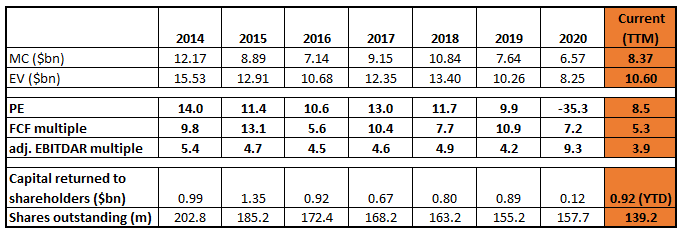
This target on Kohl’s back is not surprising. KSS is a cash flow machine and over the last 5 years has returned half of its current market cap to shareholders through dividends and repurchases. The company is also cheap trading at TTM 8.5x PE, 5x FCF, and 4x adj. EBITDAR. Kohl’s is similarly undervalued on 2019 results.
However, it’s not the low multiples “per se” that makes the company so attractive to activists as the whole retail sector is priced similarly. What makes KSS stand out from its peers is $8.8bn of owned real estate (at cost incl. land and buildings) on the balance sheet. This is equivalent to the current market cap.
Activists have been pushing the board to monetize real estate assets for a while now.
Macellum Capital (owns 5%) is an experienced retail sector activist with an impressive track record of unlocking value on retailer balance sheets. Kohl’s is the 7th campaign since 2014 and the others can be found here. It seems that most of the campaigns have been successful and, at least pre-COVID, resulted in the substantial share price appreciation of the targets. Macellum’s playbook is to put its directors on the board (often by settlement) and then, similar to what it tries to do with KSS, push for balance sheet restructuring, non-core asset/real estate monetization. For example, in the two most recent campaigns the activist took 9/12 board seats in BBBY after which the company sold non-core assets equal to 75% of the market cap. While with BIG, Macellum appointed 3 directors and sold the real estate for $785m when the market cap at the start of the campaign stood at only $700m – the stock effectively doubled. Macellum estimates that KSS could trade at $100/share once the balance sheet is properly restructured:
Look, there aren’t many companies that trade at 2.7 times EBITDA that don’t have interest from private equity buyers. Apollo bought Michael’s at like 8x EBITDA. So there’s a significant amount of private equity interest in this name, it’s incredibly cheap, and we didn’t talk about the $7 to $8 billion in real estate. You can almost buy the company for free if you monetize the real estate. So, we are very confident that there’s a tremendous amount of private equity interest and we really feel the company needs to run a process at this juncture.
Another activist, Engine Capital, states that it knows some parties that are ready to pay at least $75/share for KSS:
Given that the Company trades at a massive discount to intrinsic value and its strategy has not resonated with the public market, we believe it is essential to run a market test to see how much well-capitalized financial sponsors would pay for the entire Company. Our own diligence leads us to believe there are financial sponsors who will be able to pay a significant premium of 50%, or at least $75 per share
The activists are now demanding the board to launch a sale process or at least start tapping into its owned real estate value. Management has been reluctant to do either so far. Last year the activists have managed to force a settlement taking two board seats (out of 12) and materially increasing the share buyback target for 2021 from $300m to $2bn. KSS management is facing significantly higher pressure now and apparently even has several takeover proposals on the table. I think the chance is high that management will give in and will either sell the company or finally start monetizing real estate assets. If that does not happen, Macellum intends to launch a proxy war again this year (meeting should be sometime in May), which, given the current context, should be much more successful compared to the last one.
There is more than one way to win here. I think the chance of the first two scenarios materializing in one way or another is much higher than the third option.
- KSS is sold. There’s an 8% spread to the current rumored offers, but fundamentals and activist comments make it pretty clear that the rumored $64/$65+ bids are only starting point of discussions and there’s substantial headroom for the increase. The situation could easily escalate into a bidding war and I would expect the final price to be more than $75/share.
- Activists are successful in pushing KSS to monetize real estate assets. With newly raised funds the company would be able to ramp up buybacks and increase the EPS substantially. Macellum estimates it could increase EPS by 55% after monetization of half of RE assets.
- Even if none of the above materializes, KSS will continue to generate a substantial amount of cash. I expect it to eventually increase the currently suppressed dividends to at least pre-COVID levels and continue to buy back a substantial amount of shares each year. Valuation should rebound to more reasonable metrics once the whole retail sector normalizes.
Before the takeover interest confirmation (Jan 24th) KSS traded at $46/share, or 25% downside from the current prices. However, I believe the risk is actually much smaller in this case.
Short background and timeline
I’ll not go much into detail into last year’s campaign, which was run by an investor group of 4 PE firms (owned 9.5% combined) led by Macellum Capital. The main 27 pages letter of the activists can be found here. They announced board nominees, but eventually, the parties settled in Apr’21 for 2 board seats as well as KSS agreeing to strengthen its capital allocation oversight and expand the existing share repurchase plan for 2021 from $300m to $2bn. Of this buyback amount, the company managed to repurchase only $1.3bn during 2021. Macellum complained about it in the most recent letters.
As for the more recent events:
On the 6th of December’21 – activist hedge fund Engine Capital wrote an open letter to the board saying it’s disappointed by KSS underperformance vs indexes and peers and offered the path to separate KSS legacy retail business and e-commerce business. Engine claims that the e-commerce business alone could be worth $12.4bn, more than the current KSS EV on 2x sales valuation multiple (which it calls conservative). Additionally, Engine said that the board should consider selling the whole company as there are multiple interested parties that could pay at least $75/share for the whole firm. Engine Capital owns 1% of KSS.
18th January’22 – Macellum Capital came back to the activist stance saying the board has wasted another year and urged KSS to refresh the board, consider real estate monetization and launch a strategic review. The activist also raised a number of issues with the company’s operational strategy, including a need to refresh product assortment, increase the efficiency of sourcing, align executive compensation with shareholder value creation, etc. Macellum Capital owns around 5% of KSS and claims that the company has significantly underperformed its peer group and trades way below the peer average (refer to the tables in the “Some thoughts on valuation” section below).
The activist also said that Kohl’s has been approached by multiple interested bidders and the board has just kept rebuffing them:
We also have heard that the Board and its representatives have been approached and rebuffed overtures from credible buyers. This is unacceptable and, if true, would seem to constitute a meaningful breach of the Board’s fiduciary responsibilities
18th January – Kohl’s made a response saying that Macellum’s claim about the potential bidders is “unfounded speculation” and promised to announce an updated financial framework and capital allocation strategy on the investor day on March 7, 2022.
21st January – several media articles appeared rumoring that Acacia Research, backed by a prominent activist Starboard Value has approached KSS with a $64/share cash bid.
24th January – more rumors appear that PE firm Sycamore Partner has joined the bidding and is willing to pay at least $65/share.
24th January – KSS confirmed the receipt of expressions of interest.
25th January – Macellum issued a letter urging the board to initiate a review of strategic alternatives and add activists’ representatives to the committee. It says the board has “has Impugned its Credibility by Calling Macellum’s Assessment of Potential Acquirers “Unfounded Speculation” Just Days Before Confirming Expressions of Interest”.
So far the board has been shy on details, but we will likely hear more in the coming weeks.
Kohl’s Business
KSS operates 1162 retail department stores in 49 US states. 95% are off-mall, either stand-alone or in power strips. The company sells women’s, men’s, junior’s apparel and footwear plus various accessories and home products. The offering is at more of mid-price levels. Recently, the company has entered into a partnership with Sephora (premium beauty retailer) to add Sephora’s beauty shops into Kohl’s stores (shop-in-shops). 200 Sephora shop-in-shops have already been opened and 650 more will open by 2024.
The business growth has been stagnant for many years now, however, the topline is stable and the company still generates a substantial amount of FCF. This has allowed the company to return a significant amount of capital to shareholders through dividends and share buybacks:
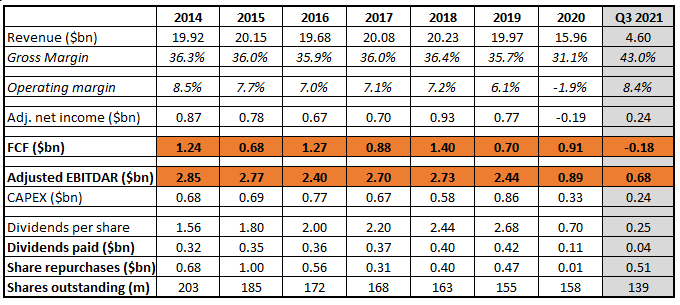
2019 margins were affected by competitive/pricing pressures, especially in home and women segments – this was a difficult year for many retailers for similar reasons. In 2020 the company was hit by COVID and suspended dividends/share repurchases. Stores were closed for several months during the year, however, this has resulted in substantial growth of the digital segment (the company provides only limited data on this):

2021 saw customers returned to brick and mortar stores after the COVID restrictions were eased. KSS reinstated dividends in Q2’21, although at a much smaller than pre-COVID. Pressured by Macellum Capital’s campaign, the company also ramped up its share buyback program – from the initial plan of $0.3bn to $2bn. In the first 9M of 2021, KSS has repurchased around $0.8bn of stock and management expected to repurchase another $0.5bn during Q4. In the first 9M of 2021 KSS was buying at around $52-$53/share average price, not that far away from the current levels.
During 2021 the company has also increased its full-year guidance three times with the latest one forecasting revenue growth mid-20%, operating margins of 8.4%-8.5%, and EPS of $7.10-$7.30.
Kohl’s real estate
KSS operates 944 strip centers, 155 free-standing shops, and 63 community or regional malls. Out of all, KSS fully owns (land+buildings) 409 stores and further 237 are ground leased (owns the building but leases the land).
Additionally, the company operates 9 distribution centers (owns 7) and 6 e-commerce centers (owns all of them), owns a corporate HQ building in Wisconsin, and several other additional offices.
Most of the real estate (around 75%) was acquired during 2000-2010.
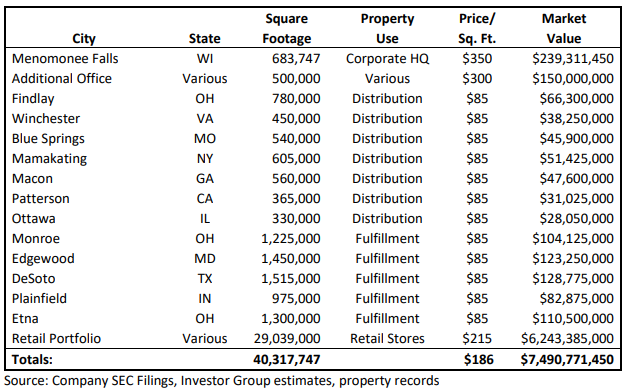
In the latest 10-K the reported at-cost value of the owned buildings stood at $7.8bn ($56/share). Land is valued at an additional $1bn.
Last year, the activist Macellum Capital estimated the total value of KSS owned buildings at $7.5bn (not sure if this figure also includes the value of the owned land):
Sale-leaseback proposal – valuable real estate
Pretty much the core agenda pushed by the activists is the monetization of KSS real estate assets and then usage of the proceeds to cover the debt and return capital to shareholders. Macellum claims that KSS could sell those assets at 14-15x EBITDA. Last year it also noted that it knows some PE firms which have already approached the board multiple times with the intention to buy the buildings, so once the board gives its blessing, the restructuring could be done rapidly (activist letter).
We are aware of at least one private equity real estate investor that has approached the Company on multiple occasions about executing more sizable sale-leaseback transactions, but has been turned away each time. The Investor Group believes that the Company could unlock at least $3 billion through sale-leaseback transactions with a high degree of certainty in 60 to 90 days. Such transactions would enable Kohl’s to effectively sell non-core, non-earning assets for approximately 14-15x EBITDA
This kind of proves that real estate investors consider assets owed/occupied by Kohl’s to be able to generate stable rent income going forward. In other words Kohl’s business is unlikely to go down the same path as Sears.
Other activists from the last year’s consortium have also made numerous comments on real estate monetization. E.g. Ancora Holdings (it also worked with Macellum on several other retail sector campaigns):
And so, when you see something like that where you have an asset that is getting effectively no value from the market, oftentimes unknown by the market because the disclosure requirements under GAAP are very limited in terms of what you have to say about your real estate value or term market value real estate So, here you have a situation where you have a stock that’s trading at a really low multiple, and that was true of Kohl’s when we started this campaign too. And then, you have real estate value that’s a significant portion of the overall evaluation, but most likely not getting any credit from the market in general.
[…]
I mean, it doesn’t have to be used just for buy-backs. It can be used for deleverage. There’s a bunch of different opportunities. In the case of Kohl’s, I think that pathway remains to be seen, but certainly, the same groups that we’ve worked with in both Bed Bath and Big Lots are certainly aware and have looked at this Kohl’s situation very carefully. And so, we do know that there is interested parties that would like to execute this type of transaction
The board has historically been reluctant to do sale-leaseback transactions and so far has rebuffed such proposals based on other available low-cost capital alternatives. KSS CEO from March’21 presentation:
There was one particular idea, as you mentioned, the sale leaseback that, as we sit here today, we’re not in favor of. We think we have other alternatives that are more accretive to the value of the company. We’re not opposed to sale leaseback. You saw us do that last year when we did need access to capital at a time where we are navigating a very tricky situation with the pandemic. But with interest rates, where they are today, it just really doesn’t make sense to implement a sale leaseback.
Another comment from April:
The only proposal the Activists have offered that we are not currently pursuing is a form of short-term financial engineering – a sale-leaseback transaction. This would be an inefficient means to access capital for Kohl’s given current market conditions, and as a result would destroy shareholder value. A sale-leaseback transaction would add operating risk (e.g., by increasing rent expense and leverage) and would likely negatively impact our investment-grade rating.
Macellum, on the other hand, says similar leaseback transactions have generated substantial value for other retailers (e.g. their own campaigns). The activist estimates 55% Kohl’s EPS increase if even only $4bn real estate is tapped into. This would be a far superior move in terms of shareholder value than any potential debt financing (activist letter):
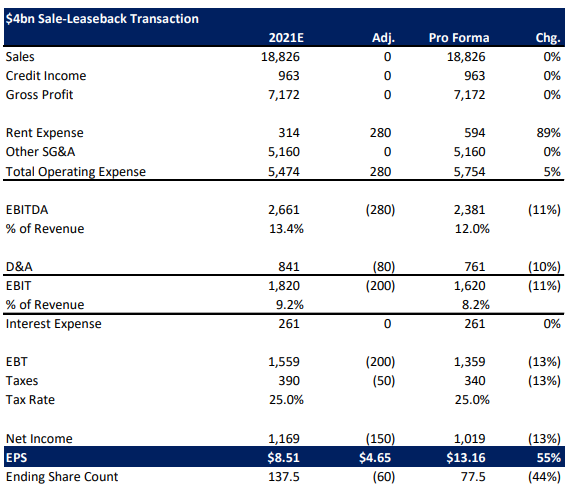
$280m rent increase on $4bn property value implies a 7% cap rate, which is in line with current shopping REIT valuations, so calculations kind of make sence. Macellum also assumes that KSS will be able to buy back 60m shares (nearly 50% of the current outstanding) at an average price of $67/share, which also seems somewhat reasonable given the 4.6m average daily trading liquidity and market share price of $50+ at the time.
Some thoughts on valuation
KSS currently trades at TTM multiples of 8.5x PE, 5.3x FCF, and 3.9x adj. EBITDAR and has the cleanest balance sheet in many years ($2.2bn net debt). The company also trades below its historical valuation levels. One could argue that TTM earnings are not sustainable, however, KSS is actually also inexpensive based on 2019 pre-COVID earnings – 10.9x PE, 12x FCF, and 4.3x adj. EBITDAR. This is partly driven by the reduced share count after large stock repurchases last year.
The activists have been very vocal about KSS undervaluation relative to competitors. From the recent Jan 18th letter:
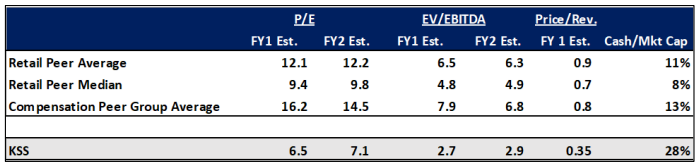
KSS share price performance vs peers:
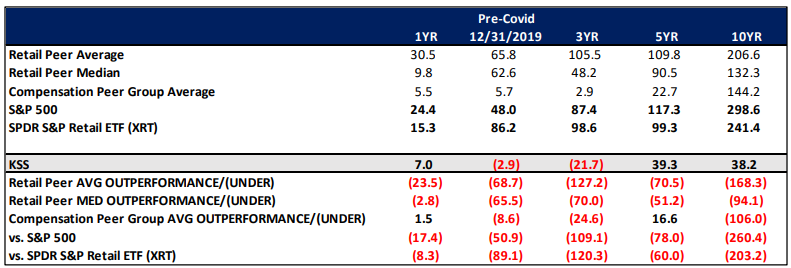
Revenue growth vs peers:

The valuation gap looks very significant, however, there are two important things to note here. First, it is not exactly clear how Macellum comes up with 2.7x EV/EBITDA valuation. Second, the peer group in these tables also includes various retailers in other sectors or of much larger scale, etc., and not all of those are not really directly comparable to KSS. The undervaluation picture being painted by the activist might be a bit too rosy.
Probably the closest peers are Macy’s or Dillard’s – the company itself used to say it’s doing “better than Macy’s and Dillard’s” when fighting the activists before (both are also included in the activist’s peer group above).
So let’s compare KSS with closer peer group instead:
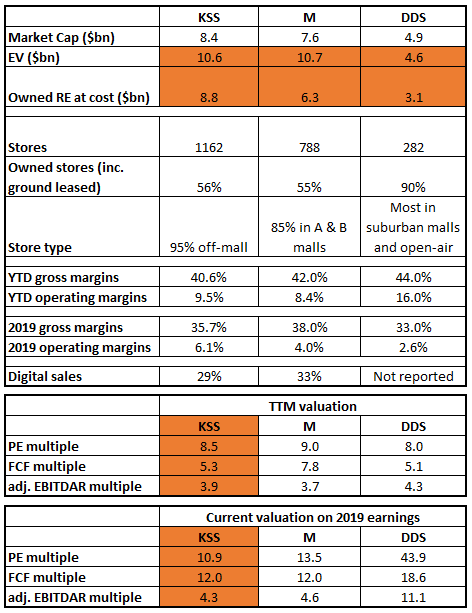
Taking this narrower peer group makes KSS valuation much more reasonable, although Kohl’s is still noticeably cheaper based on 2019 earnings. However, taking into account the value of real estate on the balance sheet, KSS is a clear outlier – KSS owns $2bn (40%) more RE than Macy’s on basically the same EV, while both firms are valued similarly on a TTM basis and operate at similar margins. Macy’s is also targeted by an activist, although the proposal aims to split e-commerce and legacy businesses rather than monetize real estate. Meanwhile, it’s fair to say that DDS deserves a discount due to weaker margins historically and a dual-class share structure, with the founding family controlling the company and the board and with limited prospects for any activists pressure. Among the 3 companies, KSS seems to provide the most interesting opportunity for investors/activists given both the current valuation and opportunity to monetize real estate assets.
Company rejects buyout offers, saying they’re too low, adopts poison pill “so it can consider offers in an orderly fashion”. News out before market open Feb 4. Price down at first, now at 9:35am flat.
Cowen Equity Research: ” … 20 to 30 percent chance, more or less, of a deal at $64 to $65 per share, and a 30 to 40 percent chance, more or less, of a deal getting done at $75 or higher.”
https://finance.yahoo.com/news/kohl-rejects-takeover-bids-counteroffers-182704363.html
Based on above, roughly 60% chance of $70 or $10 upside from $60 current price. Downside: before confirmation of takeover interest, price of $46, or $14 downside. Based on these numbers, $60 is the expected value. (BUT , per DT, downside is probably much smaller).
My take on situation:
Chance for a deal at $65 is much lower now with poison pill?
So either this is sold for $75+ or it goes back to ~$50-55.
Assume 60% chance KSS is sold for average price of $85, and 40% chance it goes back to $55 if there is no agreement and it takes 9 months, then expected value is $73 per share and expected CAGR is ~31%.
Risk here is a potential deterioration of results while the sale process is ongoing. Margins were weakening in 2019 before the pandemic. And negative operating leverage is always a major risk with these retailers (see Sears). But that should be mitigated by the short time frame here. As long as margins don’t show signs of serious weakness this year, stock price will probably be above $50-55.
KSS stated it would update shareholders on its plans at its investor meeting on March 7.
Macellum Capital has expressed their disappointment in their most recent statement and intends to nominate a slate of director candidates to KSS’s board:
“We will do everything in our power to prevent the current Board from continuing to chill a normal-course sales process. In our view, the Board’s cumbersome Friday morning press release and adoption of a poison pill that has a lower trigger for investors that may seek more active engagement with the Company demonstrate shareholders’ interests are not the top priority in the boardroom. It seems to us that the Board is taking unprecedented steps to derail a credible process and kill interest among the growing crop of possible buyers of Kohl’s. Fortunately, the slate we plan to nominate in the coming days will be far more aligned, experienced and openminded when it comes to pursuing all paths to maximizing value.”
https://www.businesswire.com/news/home/20220204005419/en/Macellum-Expresses-Disappointment-Regarding-Kohl’s-Seemingly-Mismanaged-and-Poorly-Communicated-Strategic-Review-Process
Also, Morgan Stanley previously estimated that a bidding war could lead to a $75-$95/share offer.
https://seekingalpha.com/news/3791361-kohls-may-see-70-95share-takeout-price-in-a-bidding-war-analyst-says
KSS – Proxy war is ongoing. Macellum nominated 10 nominees to the board, whereas KSS has apparently hired Goldman and PJT partners to review expressions of interest. Only “qualified” bids will be reviewed. Macellum is skeptical on this, from the latest proxy:
It was also reported that Leonard Green & Partners (PE firm) has reached out to KSS regarding potential bid.
https://www.bamsec.com/filing/92189522000419?cik=885639
https://www.nytimes.com/2022/02/10/business/kohls-sale-board-bidders.html
Do we know when’s the latest KSS has to hold it’s 2022 annual meeting (as per bylaws)? Marcellus has ~ 3 nominees on the 14 member board and has nominated an additional 10. Reads like they want enough nominees on the board to control the Finance Committee. If and when they control the board, is 3 months for a sale process (assuming a couple of rounds) and 3.5 months from definitive deal to close fair timing? I’m assuming the value at which the real estate portfolio can be monetized, a sale leaseback or an asset based financing is going to drive what financial sponsors are going to be willing to pay…
Proxy war is ongoing. Macellum has issued a letter saying it is disappointed KSS with Q4/2021 results and that management’s strategy is not working – the main argument being 2021 revenues falling short of pre-COVID 2019 numbers, whereas peers saw significant top-line growth vs pre-COVID numbers (Macy’s +28% and DDS +37%). Management will provide more information on the 2022 strategic plan on the 7th of March. Also, management promised to release proxy docs with a lot of details on the ongoing sale review later this month.
A few highlights on the annual/Q4 results:
– 2021 revenue at $19.4bn – 22%+ YoY, but still slightly below 2019 pre-COVID levels.
– Operating margin 8.6%, above 8.5% upper guidance range.
– EPS $7.33/share, above the $7.30/share upper range of the guidance.
– FCF at $1.56bn in 2021.
– KSS has spent $550m to repurchase around 10m shares (average price around $55/share) during Q4. A total of $1.35bn was returned to shareholders through repurchases during 2021. On top of that KSS paid $147m in dividends.
– The company has also increased the quarterly dividend to $0.5/share from the previous $0.25/share (used to be $0.67/share pre-COVID).
As for 2022, management expects 2%-3% revenue growth YoY, operating margin at 7.2%-7.5% and EPS at $7-$7.5/share. Capex is expected to increase to $850m (against $605m in 2021) due to the build-out of Sephora stores. KSS expects to spend another $1bn on share repurchases in 2022, with half of that in Q2’22.
Macy’s guidance for 2022 was flat-1% growth in revenues and 18% drop in EPS. DDS doesn’t provide guidance.
KSS fell down 13% yesterday – probably a mixture of investors being disappointed with investor day’s update as well as overall market sell-off. Interestingly, Macy’s tumbled even more (almost 14%) on no new announcements. DDS share price stayed unaffected at the same levels.
Overall, I still like this idea. Difficult to predict how it’s all gonna turn out. But, KSS now trades below 4x 2021 adj. EBITDA and 7x 2021 PE. The company also expects to return ~18% of the current market cap through share buybacks and dividends. Real estate is still on the balance sheet and strategic review is still ongoing. There is a decent chance that Macellum’s campaign will be successful as well.
KSS guided for low single-digit sales growth, operating margins in 7%-8% range and mid-single EPS growth, which is slightly above pre-COVID levels. The company also repeated the same plan of expanding Sephora stores and also opening 100 smaller format shops over the next 4 years.
Regarding the sale process, very little additional details were provided except that Goldman Sachs contacted over 20 parties and some of those started due diligence. No additional details on the previous bids from Starboard or Sycamore either. The process is still ongoing.
Macellum, obviously, expressed his disappointment saying:
KSS proxy shed additional light on how Macellum loaded up on KSS $40 strike calls just days before starting the new campaign in Jan’21 and sold a large part of them off right after the media reports on Starboard and Sycamore takeover interests. By my rough count Macellum made $20m-$30m on the option trade and still continue to hold 1m of these options (expiring on the 15th of July). While this does not look very good, these gains pale in comparison to Macellums KSS equity position of $350m at today’s prices.
Proxy – https://www.bamsec.com/filing/130817922000038?cik=885639
Interview transcripts – https://www.bamsec.com/filing/92189522000793?cik=885639
Macellum trades https://www.bamsec.com/filing/92189522000617?cik=885639
Earnings will probably be significantly worse this year though. Which is kind of worrying, as a lot of interested parties won’t be interested anymore. Especially if there is a lot of other cheap stuff out there all of a sudden.
Two buyers plan to submit bids in the high $60s.
https://www.barrons.com/articles/kohls-stock-kss-takeover-51647450125?siteid=yhoof2
A couple of developments on KSS – nothing really new, just continuation of the same.
On the 21st of March, the company provided an update on potential acquisition offers:
https://investors.kohls.com/news-releases/news-details/2022/Kohls-Provides-Update-on-Ongoing-Review-of-Expressions-of-Interest/default.aspx
KSS also mailed a definitive proxy for the general annual shareholders’ meeting, which will take place on the 11th of May. The mailing announcement includes the usual writings of KSS saying Macellum’s nominees lack the experience to bring value creation and that shareholders should vote for KSS’s nominees.
https://investors.kohls.com/news-releases/news-details/2022/Kohls-Mails-Definitive-Proxy-and-Sends-Letter-to-Shareholders/default.aspx
Also, there is some political pressure – a democratic Wisconsin senator is urging KSS’s board to reject buyout offers:
Macellum responded:
https://www.bizjournals.com/milwaukee/news/2022/03/28/sen-baldwin-urges-kohls-to-reject-offers.html?ana=yahoo
More rumors on KSS sale process and lined-up bids:
https://seekingalpha.com/news/3819504-kohls-is-said-to-have-asked-bidders-to-submit-revised-offers
With these kind of rather precise rumors continuing to go around it is strange to see the stock still at $60 – with multiple buyers lined up and management now clearly engaging with them, seems like some kind of the deal is imminent.
My main concern is all the discussions with interested parties might be just a smokescreen for management to get past the annual shareholder meeting in May, where Macellum is offering its slate of directors. Once the vote passes, management might declare that none of the bids were ‘qualified’ enough. Is that the key risk market sees?
That is a concern for me, but can’t a special meeting be convened by those who own <10% of shares.
Franchise Group (retail stores operator) joined the bidding with a rumored $69/share offer. This is slightly below the rumored $70/share offer from Hudson Bay (luxury department store operator). KSS stock is still trading around $60/share likely due to the risk outlined by Dt in the comment above.
https://www.reuters.com/business/exclusive-franchise-group-joins-bidding-kohls-sources-2022-04-12/
IMHO, I think the key risk here is Hudson Bay dropping out of the process. If they are at $70+, the rest of it (mgmt, board slate) is workable mechanics. Hudson Bay – the strategic here – can outbid the PE firms and @$70 is anchoring price for all bidders. In paying up for a definitive financing commitment, PE firms will need a view on Hudson Bay’s bid. Hudson Bay is in the drivers seat…I suspect they know it.
Rumors are out that the owners of JCPenney, Simon Property Group and Brookfield Asset Management, made an offer to acquire Kohl’s for $68/share or $8.6 billion in total.
https://www.morningstar.com/news/dow-jones/202204258354/jcpenney-owners-make-offer-to-buy-kohls-sources-say-ny-post
Proxy firm ISS recommended against the full board overhaul, however, still sided with the activist advising shareholders to vote for two Macellum nominees (but not for Jonathan Duskin). ISS noted that adding new board members will alleviate market’s concerns regarding the board’s sincerity with the strategic review and the turnaround process.
This probably doesn’t change the thesis much, but ISS has clearly noted the market’s skepticism regarding the sale process and said that in case a buyer is not found, the short-term downside could be material.
https://www.bamsec.com/filing/92189522001415?cik=885639
https://www.bamsec.com/filing/119312522134019?cik=885639
https://www.bloomberg.com/news/articles/2022-04-29/kohl-s-activist-gets-partial-support-from-iss-for-board-changes
Activist change expected to fail. End of story for this KSS idea?
https://finance.yahoo.com/news/kohl-fends-off-activist-macellum-115902709.html
Company confirms reelection of all directors (preliminary count). Will continue both “review of strategic alternatives” and “drive shareholder value”. (My guess is that “alternatives” are out.)
Stock down about 2%. (I think the reelection is mostly expected.)
https://finance.yahoo.com/news/kohl-shareholders-elect-directors-2022-132000302.html
They still say “intentional and robust process” so I guess alternatives are not out.
Do dissapointing results and tanking share price actually increase the odds of a buyout happening here?
“A source tells Yahoo Finance that as a result of the bad quarter, Kohl’s may now be unable to sell itself. And if it does reach a deal with a suitor, it will be at a substantially lower price than if the business was sold months ago.
So in effect, Kohl’s management and board is being viewed as majorly fumbling a process to maximize shareholder value.”
https://finance.yahoo.com/news/kohls-activist-investor-rips-alarming-behavior-by-company-115842827.html
One would think that a knowledgeable buyer would not change their mind based on a single quarter…
“Kohl’s main potential bidders are said to be on the sidelines because they are having trouble getting financing for a deal, according to a CNBC report.
A deal can’t get financing in the $60s/share, according to CNBC’s Sara Eisen, citing a person close to the process. The lenders are said to not have confidence in Kohl’s numbers after company reported its Q1 results on Thursday.”
https://seekingalpha.com/news/3841479-kohls-main-bidders-said-to-be-on-sidelines-due-to-financing-concerns-report
Reuters reports that previous bidders are still interested in KSS, but potentially at 10%-15% lower price points:
“Some of them had indicated in recent days they were willing to pay as much as $62 per share for Kohl’s, according to the sources. Kohl’s shares are currently trading around $36, having lost more than 40% of their value this month amid concerns that raging inflation and lower consumer spending will weigh on its business prospects.”
https://www.reuters.com/markets/us/exclusive-kohls-braces-bidders-revising-down-offers-sources-2022-05-25/
https://www.wsj.com/articles/sycamore-franchise-group-each-submit-bids-for-kohls-11654206211?mod=markets_minor_pos7
Sycamores bid in mid $50s and FRG around $60.
Curious to see how management responds to this after being given a second chance in a weak tape none the less.
To fight **and win** a proxy war claiming $70+ is fair value, then turn over the keys for $60? – would be surprising if they sold.
What would they do if they didn’t sell? Lever up a little bit and do a dutch-auction? – give shareholders some P/E upside w/out selling out?
Any opinion on what the break price would be? I have heard mid 30’s but curious to see what everyone thinks.
*KOHL’S BOARD IN THREE-WEEK EXCLUSIVE TALKS WITH FRANCHISE GROUP
*KOHL’S: FRANCHISE GROUP PROPOSAL TO BUY FOR $60.00/SHR
https://www.bloomberg.com/news/articles/2022-06-07/kohl-s-in-exclusive-talks-over-franchise-group-s-8-billion-bid
Kohl´s enters into three week exclusive negotiations with Franchise Group. The offer stands at $60 per share.
The PE upside can now be played through Franchise Group (Ticker: FRG), if the deal goes through.
Apparently, most of the financing will be provided by KSS real estate assets (I guess sale-leaseback). Quite interesting given how KSS management has been against sale-leaseback transactions before and said they will consider only bids with “proper financing”. Times change?
https://www.bamsec.com/filing/117184322004185?cik=1528930
A nice article from Clark Street Value on KSS and FRG – thinks this deal is getting done:
– FRG CEO is a creative deal maker with a good track record among potential creditors.
– The deal resembles other recent FRG transactions.
– Proforma for the merger FRG/KSS trades at only 2.6x EBITDA (assuming $6bn is financed through sale-lease back of certain KSS real estate assets)
http://clarkstreetvalue.blogspot.com/2022/06/franchise-group-in-exclusive-merger.html
FRG is freeing up its balance sheet, potentially in preparation for KSS acquisition. FRG completed sale-leaseback of three distribution centers to Oak Street. The sale-leaseback of corporate headquarters should be concluded by the end of Q2.
Also, a report came out that FRG would be open to keep KSS management in place should the sale occur. Apparently, this is a standard playbook for FRG – they have a track-record of retaining existing management teams.
3-week exclusive talks between FRG and KSS are set to expire mid-next week. Given recent developments, these will likely get extended into mid-to-late July if an agreement is not reached by then.
https://ir.franchisegrp.com/news-releases/news-release-details/franchise-group-announces-sale-ws-badcock-corporation
https://www.reuters.com/markets/us/exclusive-franchise-group-talks-keep-kohls-management-team-after-sale-sources-2022-06-21/
Franchise Group considers lowering Kohl’s bid closer to $50 a share from about $60, source says
“Franchise Group has lined up financing with lenders, the person added.”
https://www.cnbc.com/2022/06/22/franchise-group-considers-lowering-kohls-bid-closer-to-50-a-share-from-60.html
Yet another rumor – new media reports have just come out that KSS called of the talks with FRG. No public announcement from KSS yet.
https://www.cnbc.com/2022/06/30/kohls-terminates-sale-talks-with-franchise-group.html
Deal’s out indeed. Premarket at $29, down 20%. Close idea?
https://www.thestreet.com/markets/kohls-stock-plunges-as-retailer-scraps-franchise-group-sale-talks?puc=yahoo&cm_ven=YAHOO
It’s official now. Surprisingly Kohl’s was the one who called off the talks. Will be interesting to see where they go from here.
https://investors.kohls.com/news-releases/news-details/2022/Kohls-Concludes-Strategic-Review-Process/default.aspx
Quite unfortunate development with KSS. The company sale thesis has clearly failed. However, I think the stock is oversold right now. The market seems to be pricing in a solid recession and piles in KSS together with other retailers, while completely forgetting about its RE portfolio. The bad press of the recent events and the impacted credibility of the management might play a role here as well. I think the market is overly pessimistic right now and the stock will eventually rebound in either of the two scenarios – management delivers on its current promises (buybacks/partial RE asset sale) or it doesn’t and will get replaced with more competent guys next year.
KSS trades at 4.2x 2022 PE guidance and 3.5x E2022 adj. EBITDA. On a quick glance, that’s more or less in line with other retailers, e.g. Macy’s trades at 4x fwd. PE and 2.6x fwd. adj. EBITDA, GAP is at 4.5x fwd. PE, etc.
However, what makes KSS much more interesting is its RE portfolio – $8.8bn at cost vs current EV of $7.6bn. In comparison, Macy’s has just $0.5bn lower EV – $7.2bn, but $2.5bn lower RE portfolio of $6.3bn compared to KSS.
KSS management said it will explore opportunities for portions of RE. This might sound like damage control, however, given the needed capex to build Sephora stores and promises of large buybacks, that extra cash will be very useful. Finding buyers for separate assets shouldn’t be a big issue given how many potential bidders were lined up at the door just recently. Any moves toward RE realization should be very positively welcomed by the market. After rejecting bids at over 100% premium to current prices + failed strategic review management needs to do at least something to partially redeem itself. Otherwise, its pretty much guaranteed to be ousted at the next annual meeting.
Another promise was to launch a $500m (around 14% current market cap) buyback program right after Q2 results, expected in mid-August, which should help the price recovery as well.
As my initial KSS buyout thesis has failed dramatically, I am removing it from active SSI ideas. This is now a valuation case where KSS-owned real estate assets exceed the current EV. Some catalysts, like partial disposals or sale-leasebacks, might be expected over the coming year, but a full company buyout is clearly off the table. Initiation of buyback (expected to be started in August) might help the share price from it’s lows, but it is not clear yet how vigorously will the repurchases be implemented.
Marking this at 52% loss in half a year.
Reuters reports that an activist hedge fund, led by former Canadian Prime Minister Stephen Harper, is urging Kohl’s to consider a sale. The activist group is also seeking representation on the board.
https://www.reuters.com/markets/deals/former-canada-prime-ministers-hedge-fund-pushes-kohls-sell-itself-sources-2024-02-06/