
Metacrine (MTCR) – Merger Arbitrage – 22% Upside
Current Price: $0.48
Offer Price: $0.58
Upside: 22%
Expected Closing: Late 2022
This idea was shared by Brooks.
Summary
This is a very similar setup to the TYME/SYRS idea – another all-stock microcap biotech merger that is basically an alternative way for the buyer to raise equity in a tough market environment. Last week, clinical-stage biopharma Equillium (EQ) announced it was acquiring Metacrine (MTCR) in an all-stock transaction. Equillium is pretty much solely interested in Metacrine’s net cash, as they are not planning to retain any of MTCR’s employees or assume any incremental opex. The spread stands at 22% at current prices, and the transaction is expected to close successfully by the end of this year. However, the exchange ratio depends on EQ share price at the time of closing as well as MTCR’s net cash balance at the time of closing – therefore, there is some uncertainty on how to hedge the trade. EQ is expected to release an update on one of its treatment programs that could materially impact EQ share price and in turn the exchange ratio.
A hedge ratio of 0.16x seems to provide the best risk/reward opportunity here. Borrow is cheap at the moment with ~80k shares on IB at 2% fee. An unhedged trade could provide significant upside if EQ’s upcoming data readout is positive, however, an unhedged position is much riskier.
Strategic Rationale
This transaction is an alternative way for Equillium to raise equity under challenging market conditions, especially in biotech land. Equillium hopes the merger will extend its cash runway to 2024 as the company works to continue developing new therapeutics focused on treating autoimmune and inflammatory disorders. EQ CEO Bruce Steel laid out the strategic rationale for the deal on the conference call well.
And from the Equillium perspective, this is what we consider to be largely an acquisition for the cash and runway extension we get out of this transaction. We are expecting to onboard approximately $33 million in cash [author’s note – gross cash] at closing. I should clarify that closing is expected to take a couple of months here as we go through the formal process of regulatory submissions and then shareholder votes that will be required to complete the transaction. But this is an important addition to our balance sheet as we think about our operating plans going into the future, while this extends our runway into—comfortably into the 2024 timeframe.
Equillium has several trial results expected later this year and in 2023. The acquired cash would give them sufficient funding to get through those trials. The transaction also makes sense for Metacrine shareholders as the company has struggled since its 2020 IPO and then in May’22 Metacrine announced a strategic review while winding down some of its R&D earlier this year.
Executives at the two companies were close before the transaction. Both companies are based in San Diego, and Equillium’s CEO mentioned that they had known Metacrine executives and board members for some time. Metacrine’s CEO, Preston Klassen, will join the EQ Board of Directors following the transaction.
Equillium does not plan on adding any incremental opex or bringing on any full-time employees from Metacrine. EQ also stated they don’t plan to pursue any of MTCR’s existing R&D programs, although they said they will evaluate partnership options to advance Metacrine’s farnesoid X receptor platform, which includes MET 642 (oral treatment for inflammatory bowel disease) and appears to be MTCR’s most far along in development.
Closing Conditions
Aside from customary conditions, the only other closing requirements are approval from the majority of both shareholder bases, and Metacrine net cash at closing being at least $23 million. Approval from Equillium shareholders shouldn’t be an issue as insiders own ~29%, and the company would likely need to raise capital in a more dilutive way to stay afloat if this merger doesn’t get approved. From what I can tell Metacrine appears to have a decent composition of retail shareholders, so that vote may potentially be a bit harder. However, I see little reason for why MTCR shareholders would cling to their shares at this point and not take the offered premium to existing cash balances. MTCR has completely obliterated shareholder value over the last two years. It IPOed in Sep’20 at $13/share. Five months later in Feb’21 the company announced that due to insufficient trial results it is canceling the main development program. It’s share price crashed and currently stands at only $0.48/share. At the moment the most advanced MTCR development program is still in a very early stages (Phase 2a, proof of concept). Cash burn is high and the company would likely need to raise further funds. Metacrine has also traded below its net cash since November 2021, so this merger allows holders to cash out at a premium to that level.
Metacrine should not have an issue meeting the $23 million net cash requirement at closing. At the end of Q2, the company had $38 million of cash and equivalents net of all liabilities. They burned through $6.3 million in Q2, the first quarter during which they slowed down their spending on research and development. Assuming a similar burn in Q3 and Q4 would bring net cash to $25 million, in line with management’s estimate of $26 million. I don’t think cash burn should be any higher in the last two quarters of the year, especially Q4 as the entire quarter comes after the merger was announced. EQ is not taking on any of MTCR’s full-time employees and doesn’t plan to continue any of its projects, at least on its own, so MTCR should be in wind-down mode until the deal closes.
Equillium needs additional funds to get them through 2024, so they likely set the minimum net cash requirement at a spot that would give them the necessary cushion. So overall, I think it’s reasonable to expect that management’s cash estimates should be correct and possibly even conservative.
Transaction Details
The merger is structured as an all-stock transaction in which Equillium will issue stock at a 25% premium above Metacrine’s net cash at closing. Management estimates MTCR’s net cash will be $26 million at close.
Upfront Merger Consideration” means the amount equal to (i) Company Net Cash, multiplied by (ii) 1.25.
The amount of EQ shares received for each MTCR share will be based on an exchange ratio. The calculation is a bit complicated, but the language is as follows:
Exchange Ratio” means (x) the Upfront Merger Consideration divided by the price per share of Parent Common Stock determined based on the 10 day trading volume weighted average price per share of Parent Common Stock calculated 10 trading days prior to the Closing Date; provided that in no event shall such value be greater than $4.50 per share of Parent Common Stock or less than $2.70 per share of Parent Common Stock, divided by (y) the Aggregate Fully Diluted Shares.
Basically, the exchange ratio will be equal to MTCR Net Cash at the 25% premium divided by EQ’s VWAP for the 10 days before closing and then divided by MTCR’s fully diluted share count.
The important caveat is that EQ’s VWAP is subject to a collar between $2.70-$4.50, a range well above where the stock currently trades. The bottom end of the range was set around the levels where EQ traded at the time of the merger announcement ($2.73). EQ management was also asked about whether they might adjust the price collar following the LN data release on the conference call and stated that they do not intend to renegotiate the price details of the collar in response to the readout.
At current prices and using management’s estimated $26 million net cash figure at closing, MTCR shareholders would get $32.5 worth of EQ stock from the merger. This translates into 0.26x exchange ratio and puts the consideration per each MTCR share at $0.58 – a 22% spread at current prices.
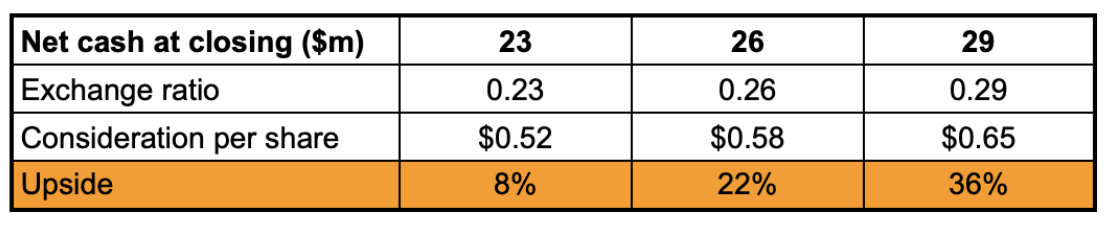
The exchange ratio is quite sensitive to the final net cash figure. For example, if Metacrine only has the minimum $23m of net cash at the time of closing (and assuming the EQ MTCR prices remain unchanged), the spread is reduced to 8%, while if they have $29m the spread 36% at current prices.
The main risk and hedging scenarios
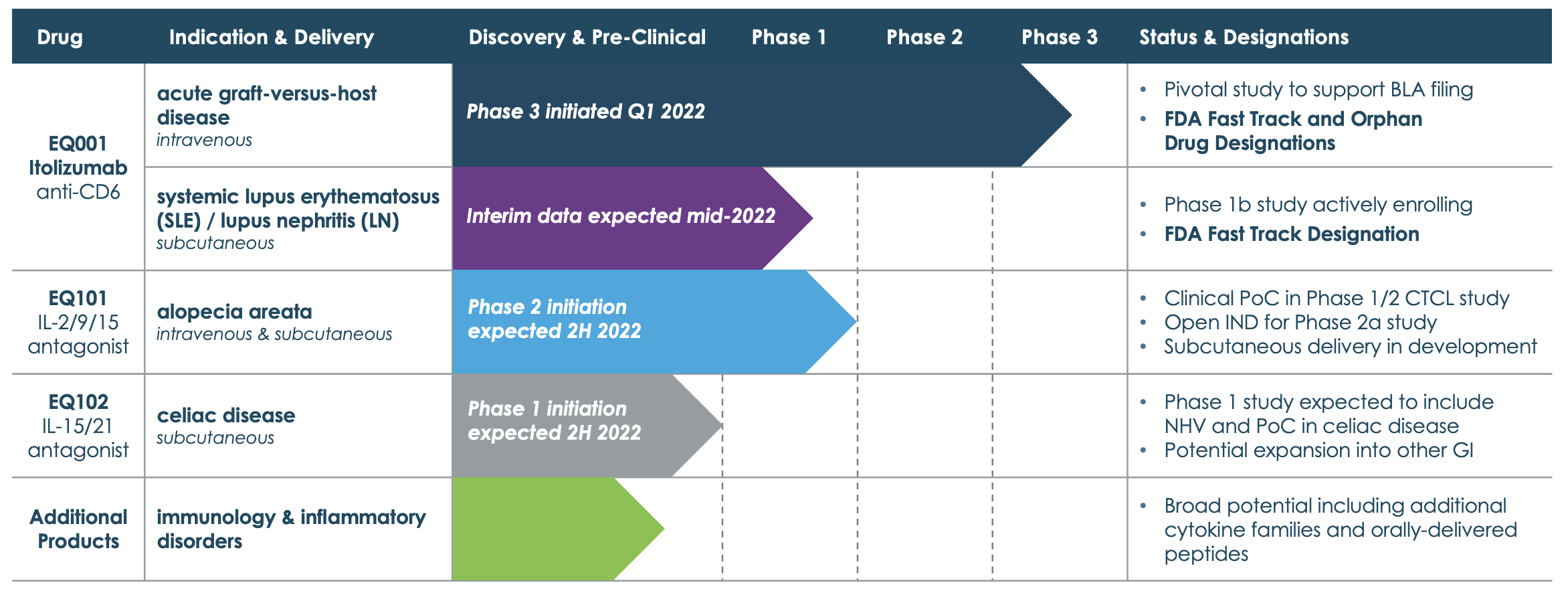
The main issue with this trade is that EQ is expected to release phase 1b data on lupus nephritis program shortly.
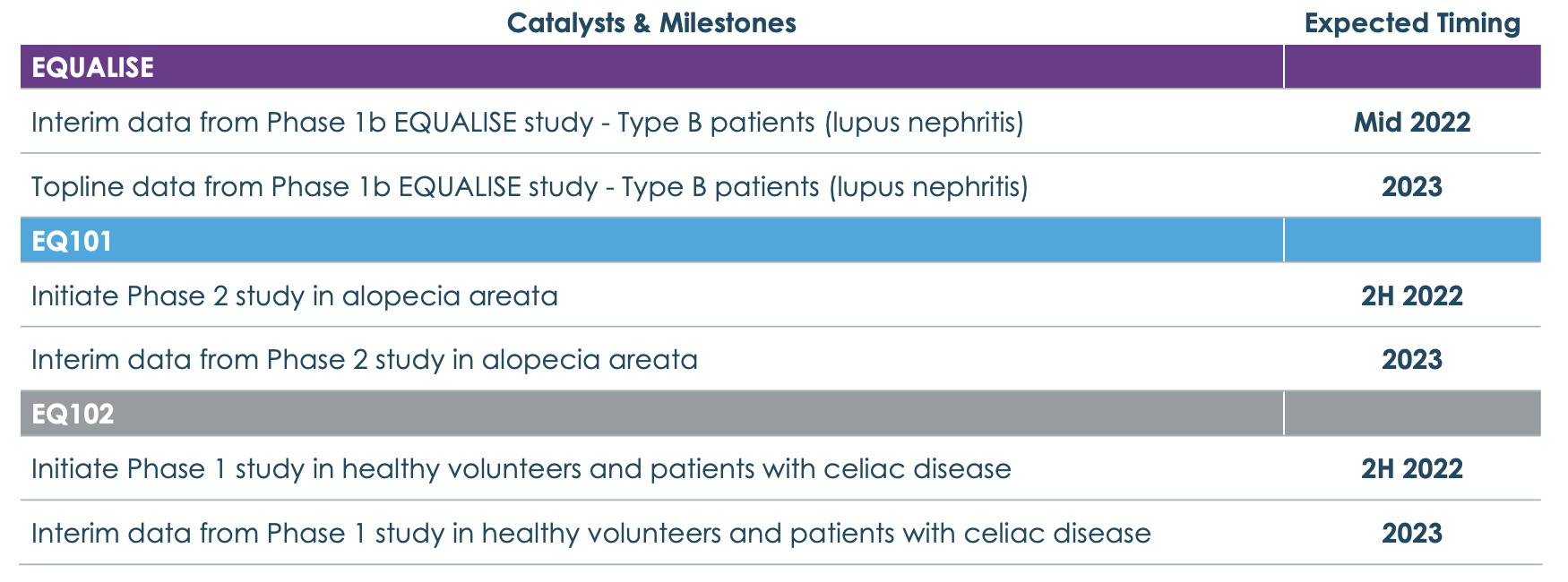
A positive readout could potentially send the shares upward against impacting the exchange ratio and hurting the short leg of the hedged trade. At the upper limit of the collar ($4.5/share), the exchange ratio would drop to 0.16x and turn the hedged trade (with 0.26x exchange ratio) into a major loss. I’ve calculated estimated returns at different estimated EQ prices at closing. Please see the table below.
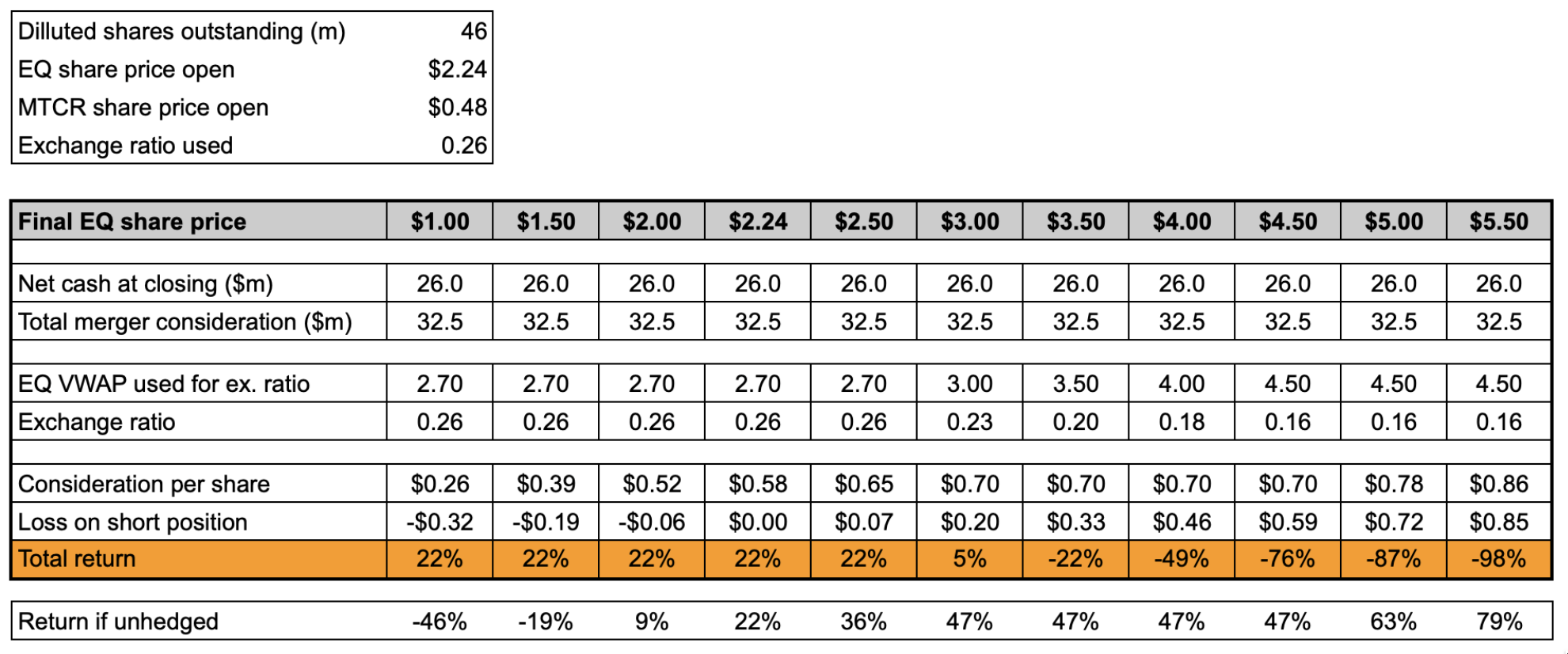
Note: shares outstanding calculated as 42.6m shares as of Aug’22 + 1m shares under ESPP + 1.4m options (ex. price $0.47/share) + 1.3m RSU.
Going into this trade with a hedge ratio placed at the current exchange ratio level (0.26x) offers a good risk reward only if the EQ share price stays below $3/share. However, in this scenario, all of the upside would get eliminated as EQ VWAP reached $3.15/share.
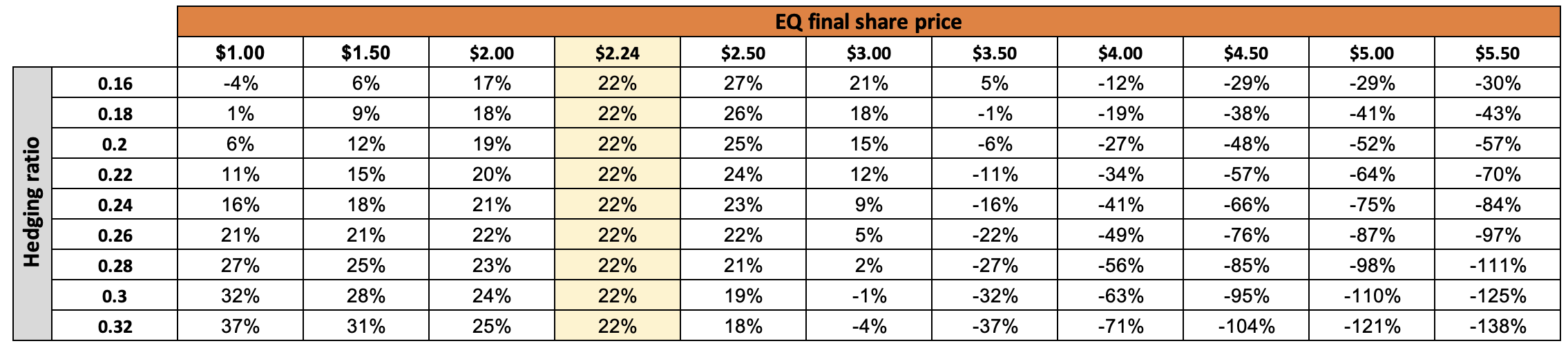
However, structuring the trade with a hedging ratio of 0.16x (in line with the exchange ratio at the upper limit of the collar) seems much more viable and interesting from a risk/reward perspective. This would provide much more safety until the lupus nephritis data comes out or Q3 results (likely in mid-November) get published. Once any new announcements get reflected in the stock prices, a fully hedged position (in line with the expected exchange ratio) could be established.
Likely the risks of EQ price overshooting are limited. The chances that a positive data from lupus nephritis program or Q3 (from EQ and MTCR) will have a material effect on the EQ share price are limited. It is not the main EQ’s development program and is still in a very early stage (phase 1b). Thus, using 0.16x hedge ratio instead of 0.26x as per the expected exchange ratio might be overly conservative.
More on risks
- Aside from the share price jump potentially impacting the exchange ratio, another related risk is limited borrow availability – sharp EQ price increase could result in a fee spike or even getting forced out of the short position.
- Net cash could drop below $26m, which would negatively impact potential returns. Based on what has been noted above, I think this risk is low and management’s estimates will prove to be correct/conservative.
- Shareholder approval risk seems low as well, however, that could change if the readout from lupus nephritis turns out negative. That would pressure EQ share price reducing the transaction premium. Nonetheless, looking at the chart EQ share price is already at the lows, and it’s not exactly clear whether this update from a secondary treatment could make such a large negative impact on the stock. From a valuation perspective, EQ has traded at a P/BV range of 0.97-2.68x (almost all cash) over the last year and currently sits at 1.95x book.
MTCR
Metacrine develops therapies to treat gastrointestinal diseases. Their main focus is MET642 – a farnesoid X receptor (FXR) platform. Equillium may seek a strategic partner to advance Metacrine’s MET642 agent for treating inflammatory bowel diseases, but they will likely wind down Metacrine’s other programs to reduce incremental opex following the transaction.
EQ
Equillium is focusing on treatments for severe autoimmune and inflammatory disorders. Their primary potential product Itolizumab (EQ001) is focused on the treatment of acute graft-versus-host disease and has recently entered a phase 3 study.
Thanks for the write up, interesting idea. In your diluted share count, you have 1.4 million options (avg exercise price of $0.47), but as of 30 June 2022 their 10Q shows that there are 4,202,631 options outstanding (1,378,817 granted during the period and another 2.8m options exercisable at more than $6). As of 31 August, MTCR says they have 4,082,608 options outstanding. Shouldn’t the 4.08m options be included when calculating the exchange ratio? The definition of aggregate diluted shares used in the exchange ratio doesn’t seem to say anything about excluding options that are deep out of the money:
“Aggregate Fully Diluted Shares” means the aggregate number of Shares, but excluding Excluded Shares, that are (a) issued and outstanding immediately prior to the Effective Time; or (b) issuable upon, or subject to, the exercise or settlement of any Company warrants, convertible securities, stock options or other equity awards or other similar securities, in each case as of immediately prior to the Effective Time.
My understanding is that the 2.8mm MTCR options with exercise prices above $6 should not be included in the exchange ratio. There would be no shares issuable upon exercise of those at today’s MTCR price since they’re well out of the money. However, the 1.4mm granted during the period with an avg exercise price of $0.47 should be included, assuming the MTCR price used for the exchange ends up above that exercise price (it’s not currently).
EQ released positive results in their LN readout a couple weeks ago. The market reacted favorably with the stock up ~20% on the day, but since then it has given up all of those gains. Management didn’t provide any material updates to the transaction. I think it makes sense to use a hedge ratio in line with the expected exchange at 0.26x from here on out as, aside from Q3 earnings, there shouldn’t be any other catalysts that would cause EQ’s price to shoot up between now and the deal close. Spread remains at ~18% at today’s closing prices.
Metacrine continues to wind-down some of its R&D and has recently entered into a license agreement for its hydroxysteroid dehydrogenase inhibitors. MTCR will receive an $1.25m upfront cash payment by October 15 with about $4.25m in possible milestone payouts in the future. Seems like a small positive, though I’m not exactly sure if this was/wasn’t included in their original $26m net cash estimate. The remaining spread is 13%.
https://www.bamsec.com/filing/119312522260628?cik=1634379
In the Merger Summary 8K, they say “The Merger is Intended to be a Taxable Transaction.” All-Stock deals are generally tax free.
Does anyone know if there’s a tax hit to the proceeds? and how much that tax hit is expected to be?
We may get more detail in the yet to be released S4.
The S-4 was already out and this explains what is mean by taxable event:
“Such exchange will result in the recognition of gain or loss in an amount measured by the difference, if any, between the fair market value of the merger consideration that such U.S. Holder receives in the merger and such U.S. Holder’s adjusted tax basis in the shares of our common stock surrendered in the merger.”
So you might face capital gains on the surrendered MTCR shares, but at the same time cost basis for newly received EQ shares will be adjusted accordingly. For arbitrageurs, there is no difference compared to tax-free mergers. This only makes a difference for those that intend to hold EQ stock for longer.
https://www.bamsec.com/filing/114036122038559?cik=1746466
The shareholder meeting to approve the MTCR/EQ merger has been set for 12/20. Expected closing date is a few days later on 12/23. Importantly, the assumed exchange ratio in the proxy is 0.282, leaving a wider remaining spread than the previous 0.26 ratio used in the writeup (17% remaining upside vs 8% based on yesterday’s close).
• Metacrine’s net cash forecast at closing has been raised from $26 to $27 million, which increases the expected merger consideration from $32.5 to $33.8 million (Net Cash * 1.25)
• The proxy also uses an MTCR share count of 44.4 million, a bit lower than the 46 million in the writeup
Brooks, how do you view the risk of MTCR shareholders rejecting this transaction?
Cash by the time of the merger will be equal to $0.6 per MTCR share, whereas merger consideration (at EQ=$1.7) is only $0.48 per MTCR share. Clearly, a straightforward liquidation would be a preferred way here. Obviously, that is not in the cards at the moment and an opposing argument could be made that without this merger MTCR is going to spend/waste the $0.12/share difference anyway, so shareholders have no chance of getting a better offer than the current merger with EQ.
“Former Attorney General of Louisiana Charles C. Foti, Jr., Esq. and the law firm of Kahn Swick & Foti, LLC (“KSF”) are investigating the proposed merger of Metacrine Inc. (NasdaqCM: MTCR) (the “Company”) with Equillium, Inc. (NasdaqGM: EQ) in an all-stock transaction. KSF is seeking to determine whether the merger and the process that led to it are adequate, or whether the merger undervalues the Company.”
https://www.prnewswire.com/news-releases/metacrine-investor-alert-by-the-former-attorney-general-of-louisiana-kahn-swick–foti-llc-investigates-merger-of-metacrine-inc—mtcr-301676097.html
This seems like usual PR/Marketing by law firms rather than an actual investigation. Every merger receives a bunch of those.
Good question – MTCR holders rejecting the vote is possible but unlikely in my opinion. I don’t think they have any incentive to reject the deal. Metacrine’s developments have either been suspended or are still in the early proof of concept stage. They would need to raise additional capital if they wanted to continue development which would be very difficult right now. Even if they did raise capital, they’d likely burn through it pretty quick.
Yes, now that EQ share price has declined a straight up liquidation would be more economical for MTCR holders, but that may take additional time which would further reduce cash. MTCR has also traded at a 50+% discount to net cash most of this year, so even at a 20% discount ($0.60/share cash vs $0.48/share consideration) the deal is still better than the status quo. None of the shareholder base has pushed back publicly against the transaction from what I can tell.
MTCR Q3’22 results came out with no surprises.
As Both EQ and MTCR have already released Q3 results, it seems there should be no further major updates till the shareholder meeting date on the 20th of Dec. 15% spread remains.
BML, 15.2% owner of MTCR plans to vote against the transaction unless collar is adjusted.
Spread just went slightly negative on this. Wonder if he is able to raise any support.
Interesting development here but I guess not that surprising given the concerns raised in dt’s comment above. The market apparently thinks the activist will succeed in the attempt to beat out a higher offer. EQ is in a clear need of capital infusion and it kind of seems that the buyer doesn’t have much wiggle room here but to raise the price to better reflect MTCR’s cash position.
BML Investment Partners is a small investment firm focused on small-caps and biopharma liquidations in particular. It held/holds positions in multiple biopharma liquidation plays that we covered previously on SSI including FBRX, ABIO, and most notably IMRA. The activist raised its stake in MTCR from 5.9% to 15.2% in the recent months.
Brooks, curious what do you think about the setup at this point? Is the risk/reward here still attractive now that the spread has been eliminated?
Really interesting spin with BML planning to vote against the deal. At the current EQ price of $1.39, MTCR holders are only receiving $17 million worth of EQ shares compared to MTCR’s net cash of $27 million.
Additionally, a few days ago Equillium entered a partnership with Ono Pharmaceutical for the development of Itolizumab. EQ will receive $26 million upfront, $37.1 million if Ono exercises their option to acquire EQ’s rights to itolizumab, and potentially up to $101.4 million more based on achieving milestones with the drug. Importantly, Ono is also funding all the R&D for the project from July 1, 2022, onwards, about $8 million per quarter. This should significantly improve EQ’s cash burn going forward from ~$14 million to maybe $6 million per quarter.
EQ will still need to raise more cash down the road, but the Ono partnership reduces their reliance on the $27 million cash injection from Metacrine. EQ had $44.5 million cash as of Q3 + $26 million upfront from Ono + $12.2 million from Ono for R&D funding from July 1st onwards. The Ono deal puts EQ in a better negotiating position when it comes to the MTCR deal, which I think reduces the chances of a change to the collar structure.
There could be decent upside left if they agree to change the collar to reflect EQ’s current price, but I don’t know how likely that is. If MTCR holders vote against the current deal, downside in theory should be limited since MTCR trades at a 35% discount to net cash and EQ share price shouldn’t react much on the short leg. BML would likely push for a straightforward liquidation in that scenario. It’s worth keeping tabs on, but I think it makes sense to take profits here with the spread eliminated.
I personally struggle to see how this deal is approved by MTCR shareholders. We know that BML is voting against the deal and the proxy mentions that non-votes count as votes against the merger. Considering the relatively fragmented shareholder base — along with the fact that shareholders would now be far better off in a liquidation — I think it is extremely unlikely the vote reaches the 50% threshold. Why would anyone vote for this? One of the reasons MTCR pursued this option was because the consideration was at a premium to net cash (at least at the time). Now MTCR trades at $17MM market cap vs $27MM liquidation value (per proxy). This makes me think that a unhedged long MTCR trade is attractive here. I think the most likely outcome is either a) EQ and MTCR re-negotiate the collar; b) MTCR liquidates after vote fails; c) vote fails and MTCR pursues another merger, which could take time and lead to cash burn. Considering BML’s involvement here, I think the first two options are most likely however option c is a risk. In the unlikely event that MTCR and EQ do merge, I expect EQ stock to re-rate as recent trading suggests market thinks this deal is dead too.
As per Brooks’ comment above, I am closing out MTCR/EQ arb case in SSI Tracking Portfolio. The spread to the current offer price has been fully eliminated and it is far from clear that if the offer will be increased due to activists’ pressure. An objection by 15% shareholder materially increases the risks of merger failing and EQ walking away, especially now when it is far less reliant on acquiring MTCR’s cash. Also, just two weeks ago EQ share price was at $1.7+, so not sure if short-term movements in acquirers’ share price should be considered indicative of the value MTCR shareholders are receiving. In a straightforward liquidation, a few million will easily get burned by various admin expenses, so MTCR shareholders would get far less than the $27m net cash.
Overall 22% gain in 3 months or 21% after deducting the borrow fees. During the 3 month holding period hedge ratio was adjusted from 0.16 >> 0.26 >> 0.282 on 12th of Oct and 11th of Nov. A large part of the gain came from the improved stock exchange ratio.
Brooks, thanks again for sharing, it was a great trade.
And now the MTCR/EQ arb trades a negative 4% spread, albeit liquidity is tight.
Merger was terminated on 12.23.22 with EQ with neither company owing the other anything. This will be interesting to see what happens next. Odds are its going to be a liquidation.
Liquidation announced. Vote in late March. Liquidation estimate in the proxy (assuming Nov liquidation) was $0.62.
Shave a couple of pennies for Nov -> March, but there’s also potential upside from assets sales.
~ 20% return in a couple of months.
where in the proxy did they show the $0.62/share estimate?
It was on their previous merger proxy (p110)
https://www.sec.gov/Archives/edgar/data/1634379/000114036122040942/ny20005542x1_defm14a.htm
Thank you. They estimated about $27m at the EQ deal closing so this makes sense.
MTCR was trading at $0.47 yesterday after hours. So more than 30% upside if $0.62 is the liquidation estimate. Why so large upside?
Because the market apparently thinks that $0.62 estimate from a September proxy is too optimistic now that another couple of months have passed in which the company took no preparations to liquidate (as they still planned to merge) until recently.
My liquidation estimate below. This does not take into account any potential asset sales.
$48.6m cash at the end of December.
-$18m for liabilities as of Q3’22. Part of these might have been repaid during Q4’22 as quarterly cashburn was $5.4m vs $2.5m during Q3’22.
-$1.7m for termination of loan agreement as announced by the company.
-$1.2m CEO severance as announced by the company.
-$2m for a couple more quarters of operating expenses.
-$5m in final liquidation expenses.
-$2m contingency reserve.
This leaves $18.7m on distributable cash vs $21m market cap. Maybe I am too conservative on some of the numbers, but I think it is really far from a clear 20% upside.
1) As per the Prelim Proxy, the Contingency Reserve is set at $1m. It can certainly change, but that’s the number in docs.
2) As per the Merger Proxy Statement, the $0.62 liquidation estimate takes into account most all of these items (i.e. severence etc), with the exception of the contingency reserve. You have to estimate add’l running costs which were already low (the company was expecting to be acquired, with no staff going to EQ) into an April distribution.
I don’t think $18.7 may be undershooting…but lets see…definitive proxy should be out soon. There’s a very low probability option in an asset sale as well.
* typo – I think $18.7m may be undershooting…but let’s see…definitive proxy should be out soon.