
Austal (ASB.AX) – Potential Takeover – 35% Upside
Current Price: A$2.22
Target Price: A$3.00
Upside: 35%
Expected Timeline: 2 months
This idea was shared by Jeremy (aka puppyeh).
Austal is a US defence shipbuilding business, masquerading as an Aussie company with an Aussie listing. The company is currently ‘in play’. Since announcing a very significant new contract a few months ago from the US Navy (for a >A$3.2bn, long-term new-build contract for the T-AGOS boats), there have been four different suitors mentioned by the press as potential bidders for the asset: Bondi Partners; Cerberus; Arlington Capital; and now (most recently and perhaps the first formal bidder) JF Lehman. The Aussie business press is usually pretty clued-in on situations like this. For various reasons, ASB appears to be a bit of a strategic asset, and as Australia’s only shipbuilder with eminent national security implications, I think there is a pretty strong likelihood you see not only a competitive auction for the asset but also perhaps a not-entirely-financial bidder (ie a ‘national interest’ bidding element) that could lead to windfall gains for shareholders.
On top of that, the timing for this arb play just got better. Last week, the stock sold-off by 14% following a large FY23 guidance cut. The market seems to have overreacted as this revision shouldn’t derail the bid process and will likely have only a marginal impact on the eventual sale price.
If a potential acquirer were to compare this business, like-for-like, with listed, similarly US-dominant plays like Huntington Ingalls (HII) – the only other listed pure-play defence shipyard operator – the valuation gap is immediately gargantuan. ASB trades around 0.9x BV compared to HII’s 2.6x. Whilst admittedly HII has grown the business far more impressively and has the benefits of added size and scale, it doesn’t really out-earn Austal – having a similar HSD gross margin/MSD EBIT margin profile. The book value comparison is most interesting to me: Austal owns a number of attractive hard shipyard assets (principally the new facility in Mobile, Alabama), that are currently under-utilized, but presumably in the coming years will win more work and generate better margins given the healthy state of the order book). Owning these hard-to-replicate assets at below book value seems, on a relative basis if nothing else, quite a bit too cheap.
Whilst I don’t think this will eventually trade at 2x book value, I simply don’t think it can be sold at book value, either. I think something north of $3 is probably a likely clearing price.
Deal intrigue and the potential ‘national interest’ angle
Austal is a shipbuilder; they build a variety of steel and aluminum ships, predominantly for the US Navy and Coast Guard (despite being an Australian-listed company), from one shipyard in the US; one in the Philippines; one in Vietnam; and one in Australia. As you might expect, the core shipbuilding business is not particularly great – lumpy, lowish margin/cash return; long lead times; with execution risks.
Hence, beyond relative value, what would potential acquirers see in this historically-mediocre asset? Other than the ground-breaking T-AGOS contract, which would apparently fill the US shipyards for close to a decade, the recent AUKUS agreement, setting in stone as it did the provision of nuclear-fired submarines to the Australian navy, theoretically opens up large new business opportunities for the likes of Austal because the increased commitment to naval defense would require a concomitant increase in spending on support vessels – the very kinds of ships Austal has an edge in manufacturing, and increasingly, in providing support services for:
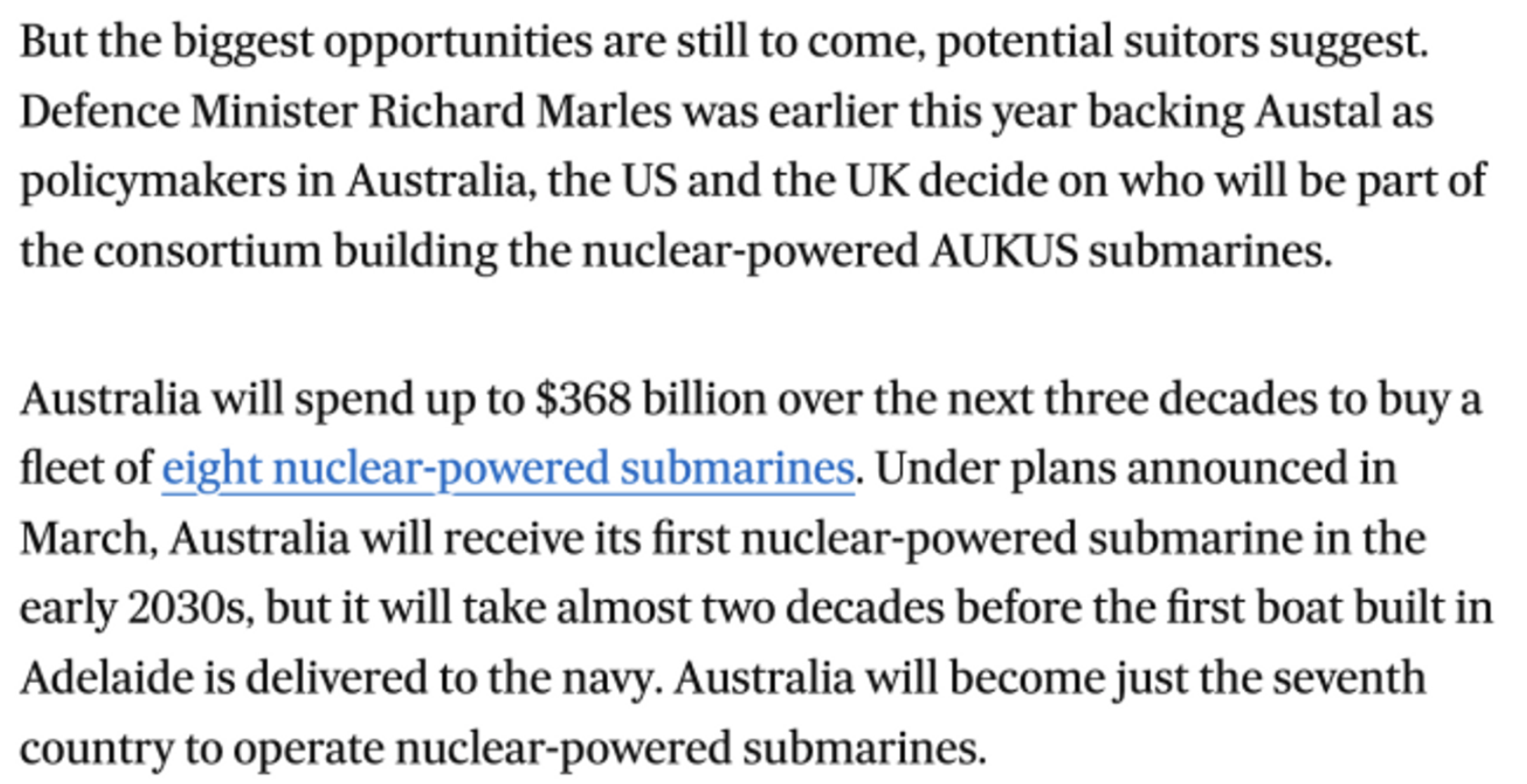
It is of course unclear what role, direct or indirect, Austal could have in the construction of the submarine fleet itself. But I believe there is enough juice here in the setup and starting valuation as to justify playing along with a modest position to at least see what happens in the initial bidding. And there is one final angle I believe the market is so far underplaying – the ‘national interest’ bid.
Andrew Forrest, of Fortescue Metals and Australia’s richest man, owns just under 20% of Austal and is therefore obviously king-maker in any transaction. Of note, he acquired the bulk of his shares during 2022, at prices around $2 or slightly lower (although he paid well over $2 for significant parcels of his stake). He sits here at a very interesting position on the register, as it seems to me he is far more likely to want to roll his equity, or indeed, buy the whole thing, perhaps as part of an ‘all Australia’ consortium, than sell up at anything close to current prices. I say that because Tattarang – his investment vehicle – is known for making extremely long-term bets; he has not been afraid to over-bid on assets in the past, especially ones he views as extremely strategic in the long-term (cf. his adventures at Noront Resources in Canada); and, more speculatively, I believe he would love to be asked to come in as a white knight by Australian government concerns if a US bidder tries to take the asset (as seems likely given recent press reports). This is, frankly, not a large asset for a man of Forrest’s means, and an incremental 20% here is a couple hundred million dollars – money that would likely be repaid multiple fold in political favors and access, should he come in in this role (as speculated in the press) in response to any foreign bid.
The recent guidance cut
Last week, the company announced a mammoth downward revision to FY23 guidance (from A$58mm to A$5mm) driven by continued cost overruns on the T-ATS build programme and an inability to (yet) recover costs from their client (the US Coast Guard). Here’s how the CEO explained the issue:
The underlying issue is that the T-ATS award was received just prior to a period of unprecedented hyperinflation. […] Some inaccurate assumptions were made regarding the efficiency of the new steel-panel line in its first project and the project has also been subject to specification changes from the original award.
I don’t want to downplay the significance of this negative development too much, but given the context here, really the only question we really need to ask ourselves is, ‘would a prospective bidder walk away after this information or not?’ – and to that question the answer seems, definitively no. There are a few angles to this supposition, but principally, it is hard to imagine any party in due diligence – and there have been at least four, over the last couple of months – were not already privy to at least some if not the full scope of this issue. But beyond that, as I discussed in the first write-up, the opportunity here is to acquire an invested shipyard asset at a highly discounted price, vis-a-vis competing businesses, in front of a multi-decade tailwind: no prospective buyer would (in my view) base their purchase decision solely on the basis of one newbuild program (and the first steel program at that).
Moreover management gave a reasonable amount of detail suggesting they ‘kitchen-sinked’ the project, not just for this year but for future out years:

They also stated, as explicitly as I suppose possible, that these issues would not recur with regard the much more valuable newer contracts that had just been awarded early this year (and for all future work):
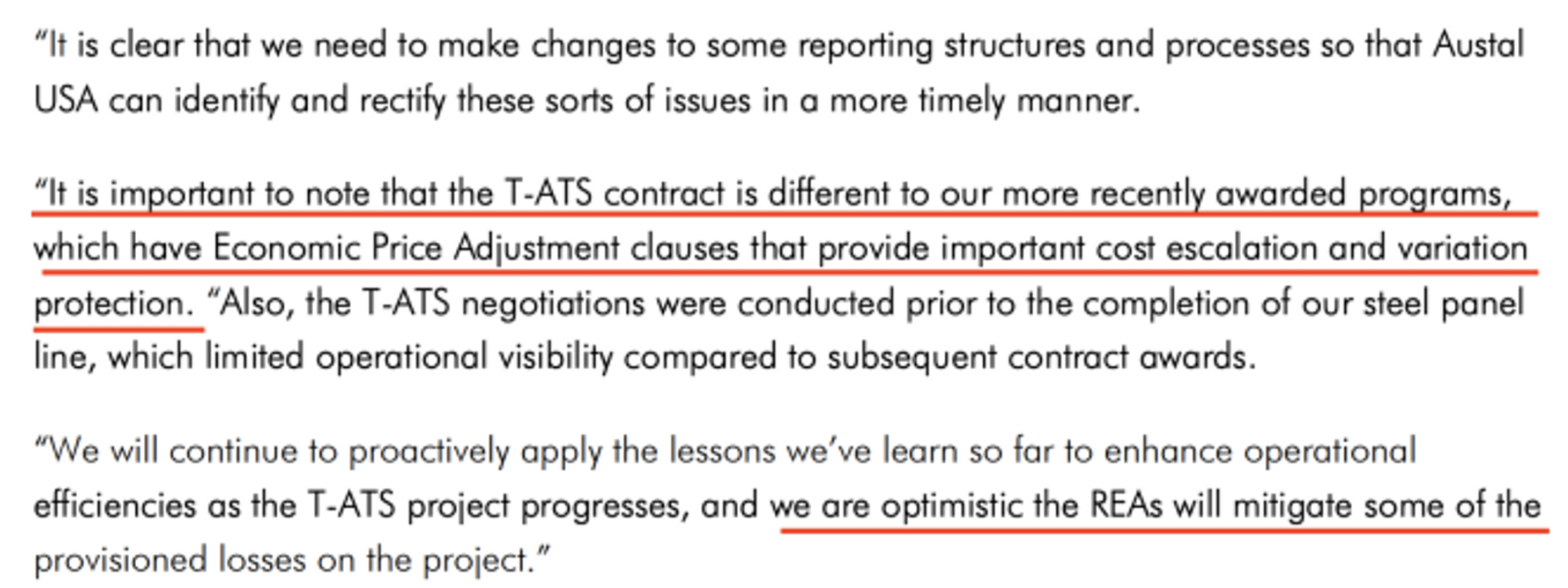
Summarizing: some first steel program teething issues; a different cost calculation method on all contracts going forward; and potentially even some of the losses generated now will come back in future years. It all seems to me, that if you were buying for the next decade forward and were inclined to think you could run the business better within this context, the only thing this overrun demonstrated more clearly is the scope of the opportunity as well as the need to put this business into new (presumably private) management’s hands. You could feasibly argue all this snafu does is make the business more saleable, both philosophically (‘management needs to go!’) and by reducing the price, at the margin.
We will need to see firm bids start to land, within the next 2 months I would say, hopefully sooner, otherwise I would be forced to conclude bidders are simply not that interested.
Thank you for the write-up, Jeremy. I’ve been keeping an eye on this one as well. Dropping some additional notes:
– One of the rumored bidders J.F. Lehman appears to have long-dating ties with the company. Back in 2005, the private equity firm’s founder/chairman Mr. Lehman acquired a couple of catamarans-ferries from Austal USA to operate in Hawaii. Lehman’s investment in Hawaii ended up in the red, however, a Wired report from 2012 suggests Lehman more than made up for the failed investment through the purchase and subsequent sale of several US shipyards to Austal’s close partner BAE Systems. From the Wired article:
“To put it plainly, Lehman’s investment in the failed, government-backed Superferry boosted Austal USA, whose rising fortunes also benefited BAE Systems, which in turn bought up Lehman’s shipyards — improved by stimulus funds — in order to work more closely with Austal USA. That roundtrip deal helped earn Lehman’s firm a reported $180 million profit. In that sense, Lehman in fact more than doubled his $85 million investment in Hawaii Superferry, with a big assist from the taxpayers.
Austal subsequently went on to win the US Navy contract to build 10 military versions of the Hawaii ferry in 2008. Curiously, Mr. Lehman is a former secretary of the US Navy. Given these facts, it is possible that Lehman could have orchestrated Austal’s military/business profile in the US.”
– Austal also appears to be of high strategic value to US private equity firms. Austal’s USA assets are located near the recently revitalized Alabama Shipyard. An acquisition would allow the prospective buyer to potentially merge the operations of two yards, combining their aluminum and steel shipbuilding capacities, in an effort to ride the industry tailwinds, including US Navy’s aging fleet and rising defense spending.
– Andrew Forest has a history of losing bidding wars, despite owning a very large stake. He was previously involved in a bidding war for Australia’s miner Atlas Iron. The company was eventually acquired by another billionaire Gina Rinehart. Atlas Iron was sold at A$0.042/share vs A$0.04/share where Forest acquired the majority of its stake. The acquisition closed successfully despite the pushback from Forest’s Fortescue Metals which controlled a blocking 19.9% stake at the time.
– One curious detail is that there has been very little reporting on the current buyout situation aside from the AFR. Craig Hopper, a defense writer at Forbes and formerly Austal’s insider who was last year the first to argue that ASB might be up for sale, has not provided any recent updates or takes on the potential takeover. Not sure how to interpret this.
excellent color, thank you!
Thanks for the idea. I’m wondering about management’s stance on a potential sale. Have they shared any comments on the bids?
not really. bit of a wildcard, although I believe any credible bids north of book value would be properly engaged. they dont have a stellar track and frankly getting out of the public markets makes sense here. i imagine the larger shareholder(s) could prob roll some or all of their equity into a PE bid (often happens in deals like this) so they can retain skin in the game
What do you consider the downside to be under a no deal scenario? Thanks.
maybe $1.8? it was $1.6 before they won that huge $3bn contract; the bidding intrigue then pushed it to $2.8 before the guidance cut put it back down here at $2.1-2.2. I don’t think it goes back to pre-contract award levels; and i imagine any deal intrigue remains somewhat supportive, even if it isn’t sold immediately. that gets you something like $1.8, maybe $1.9, which is still a pretty cheap multiple of forward earnings (assuming no further cuts, of course).
Cerberus and Arlington Capital Partners have apparently walked away follow the recent ratings downgrade.
https://archive.md/rzngb#selection-349.30-349.69
Idk if I’d say “walk away” and context of article seems suspect – Dataroom? It wasn’t a profit downgrade rather than earnings as well. Interested to hear Raper’s thoughts, it seems like his last statement would still stand tho:
We will need to see firm bids start to land, within the next 2 months I would say, hopefully sooner, otherwise I would be forced to conclude bidders are simply not that interested.
***WAS a PROFIT downgrade rather than RATINGS
Some inaccuracies in the article including the size of the stake held by Forest so can’t comment on its overall accuracy. But agree with Raper’s thesis that the bidders would have already known about the impending downgrade anyway so it doesn’t make sense they would not have already factored that in.
yes, i mean obviously not ideal to see articles like that, although it was riddled with errors. the Australian (source of that article) does not have as good a rep as the AFR (the main business paper). it is equally likely (in my view) that Arlington/Cerberus got that article printed to lower ASB’s price expectations (these kinds of games happen all the time down under).
with that said, there is no real need to delay here – the bet (for any buyer) is to own the asset in front of a 10yr tailwind, so if they want to bid I dont see why they would wait much longer. if nothing firm lands before earnings, I would probably punch out and just move on.
Thanks for that insight.
Is 21-Aug-2023 the full year financial statement release date i.e., the date by which you may punch out?
There is nothing on their website under “upcoming events” so I am just going by what TIKR says.
Bloomberg has them on the 25th of August, but has been a moving date. No formal press release of the earnings date so far.
closing this out. unfortunately this is taking too long and given what i had anticipated were numerous interested parties in advanced DD, i believe there is real risk the process is simply dead. whilst i dont think fundamental downside is too onerous from $2 (maybe another 15%), given my read on the set up was just wrong (I think) I prefer to simply move on. every chance they announce something binding in the coming weeks and I look foolish, but this is my view as it stands today.
Thanks for the update
Some recent movement on a potential sale with several players getting involved.
https://www.afr.com//companies/transport/cerberus-jf-lehman-circle-austal-as-jpmorgan-restarts-auction-20231105-p5ehpo?btis
AFR released an article with rumours that Cerberus Capital Management and JF Lehman & Company are potentially interested in a buyout with Cerberus being “most advanced in discussions”. This contradicts a previous article from the Australian where it was said that Cerberus and Arlington Capital Partners have been “spooked” due to ASB’s recent earnings downgrade.
It is said that buyers are interested in Austal’s US Navy contracts plus work related to the AUKUS defence pact between Australia, the United States and the United Kingdom. Just last year, Cerberus acquired the distressed Subic Bay shipyard in the Philippines, a former US military base close to the South China Sea.
Rumours of multiple interested parties been dragging on for a few months now with no clear offers being made as of yet is a bit concerning. However, ASB looks to have a pretty healthy order book and seems cheap at these levels, currently trading at just 0.7x book value vs 2.5x for its larger US-listed peer HII that boasts a similar margin profile.
– https://archive.md/rzngb#selection-349.30-349.69
– https://www.afr.com/companies/transport/cerberus-jf-lehman-circle-austal-as-jpmorgan-restarts-auction-20231105-p5ehpo?btis
– https://investor.austal.com/static-files/dacd9ed1-4bb2-47a8-b2ab-6d1a85c5fda0