
STAAR Surgical (STAA) — Expected Takeover — Upside 75%+
Current Price: $24.35
Target Price: $43+
Upside: 75%
Expected Timeline: 1-6 months
I first covered STAAR Surgical back in September (see here). What started as a relatively straightforward setup with an ongoing takeover, shareholder activism and a shot at a higher offer has morphed into a prolonged and increasingly bizarre saga. The situation seems to be nearing a turning point. After a few recent developments and a pullback in the share price, I think the risk/reward has improved and the setup is attractive again.
Here is the quick version of the story so far:
- STAAR Surgical is a global leader in phakic intraocular lenses, which are implanted between the iris and the natural lens to treat myopia.
- In April 2024, industry giant Alcon privately made a non-binding $58/share offer for STAAR.
- In October 2024, Alcon amended the offer to $55/share plus a CVR worth up to $7 ($62 in total). Management allowed due diligence.
- Shortly after, STAAR’s China sales fell off a cliff, going from around half of total sales to almost zero. The share price fell from ~$40 in mid-2024 to $18. Alcon walked away.
- Management said the China issues would be temporary and were mainly driven by channel stuffing and inventory imbalances. The market wasn’t buying it.
- In July of this year, Alcon suddenly returned with a non-binding $27/share offer, which was quickly raised to $28/share. These offers were also not disclosed to the public at the time.
- Negotiations moved fast, and on August 5, STAAR announced a definitive merger agreement at $28/share.
- The very next day, STAAR released its Q2 results, which included the guidance: “We expect our China revenue will normalize in the second half of fiscal 2025, as our distributors increase their purchases of ICLs to meet forecasted demand.”
- Broadwood Partners (owns a 30% stake) and Yunqi Capital (5%) opposed the takeover. They argued that China sales would normalize soon and that Alcon was trying to opportunistically snatch STAAR at a massive discount. Activists also noted that the sale process was flawed, as STAAR engaged only with Alcon and gave very limited time / basically ignored to the two other interested parties that had reached out independently.
- It was clear that the transaction would be blocked by shareholders. According to Yunqi, a total of 72% of outstanding STAAR shares were opposing the offer. All three major proxy advisory firms also recommended to vote against the deal.
- The shareholder meeting date was adjourned several times from the initial October 23.
- Last month, Q3’25 results delivered a massive rebound of China sales (from almost zero to 60% of normalized levels), supporting the activists’ case.
- Also last month, Alcon proposed that STAAR run a 30-day go-shop process. 21 potential buyers were contacted. The process was completed several days ago, but no competing bids emerged.
And now this week brought a couple of new developments:
- Alcon bumped its bid by 10% to $30.75/share.
- Broadwood and Yunqi promptly rejected it, saying the price is still far too low, and that the recent go-shop process was structured to seal the Alcon deal, not to maximize value for shareholders.
From Broadwood’s response:
The belated and appended go-shop process was not designed in a manner to attract qualified bidders and proposals: interested parties were asked to sign off-market, multi-year standstills (unlike Alcon itself, which never signed a standstill); had to subject their proposed terms to Alcon’s over-the-shoulder inspection and unilateral matching rights; and were given just days to engage with the Company.Yunqi also added:
A 30-day period is too short to support a meaningful market check for a company with STAAR’s global distribution footprint, regulatory complexity, and manufacturing profile. Any credible strategic or financial acquirer would require time to analyze regulatory conditions across multiple jurisdictions, assess pricing dynamics in key markets, conduct due-diligence on manufacturing, supply chain, and growth forecasts, coordinate consortium or financing partners, and obtain board or investment-committee approvals.
The spread to the new $30.75 offer now stands at 26%. I think that’s a good moment to get involved as the saga nears a turning point, and, most importantly, the downside should be limited regardless of which direction we turn next (there are quite a few possible directions). Pre-announcement price is $18/share, but that was with China sales hovering closer to zero for 3 quarters in a row and with market having lost any trust in management’s recovery promises. Since then, China sales are back to 60% of the previous levels, Alcon put a price tag on the company and activists started pushing for managerial changes to improve shareholder value. So even if the merger with Alcon breaks, I do not think STAAR will sell off all the way to the pre-announcement levels. I would expect the downside to be limited to 10-15%.
In a way, STAAR is a bit of a black box for investors without inside knowledge of the boardroom discussions. We now have two versions of what might be happening both in terms of its China operations and the integrity of the recent go-shop. Broadwood and Alcon hold entirely opposing views on these points, and in the end, it is difficult to judge whether Alcon is simply trying to snatch STAAR at an opportunistic moment or genuinely believes it’s offering a fair price. The only thing we can be sure of is that Alcon really wants to own this business.
Broadwood’s stance is that China sales will recover quickly and that STAAR should be worth something closer to what Alcon was willing to pay last year ($58/share-$62/share). The activist appears genuinely confident in that view. Just a few weeks ago, it bought another 1.5m shares in the $27/share-$28/share range. Broadwood has been invested in STAAR for about 30 years, so it should know the company well. At this point, it is hard to argue that the activists are merely bluffing about their conviction in the China rebound. Broadwood’s take on the go-shop is outlined in the quote above as well as on slide 13 here. The essence is that it was designed in a way that effectively deterred other interested parties from properly engaging with management.
Alcon, on the other hand, argues that the business has been structurally impaired and that China sales will not return to prior levels. It has done a fair amount of posturing to underscore this position. It refused to raise its offer for an extended period, issued a presentation on it’s “perspective” on the situation, proposed a go-shop, and despite massive shareholder pushback has delivered only a modest bump so far. Alcon is an industry giant that should clearly understand STAAR’s business dynamics. It can also now point to the failed go-shop as further leverage in arguing that its offer is the best and only one available.
The go-shop situation is actually interesting and a little funny. STAAR’s management responded to the activists by pushing back on the idea that any credible bidders had shown up. To make that point, it chose to disclose that one of the parties was FountainVest, a well-capitalized Chinese private equity firm, but noted that it approached STAAR only on the 21st day of the go-shop and that NDA negotiations consumed almost all of the remaining time. Management tried to “set the record straight” by framing this as something like “FountainVest was not a serious bidder as it would have engaged earlier otherwise.” In reality, I think this disclosure only proved the activists’ point – credible suitors were indeed involved, but the go-shop was simply too short and too heavily conditioned for any party to properly explore an acquisition.
Shareholder vote on the new Alcon’s offer is now set for December 19.
Broadwood is now working to call a special meeting to reshuffle the board and install directors who would run a properly designed sale process (one that activists expect would yield a far superior offer). If the takeover gets blocked, activists succeed in replacing the board and STAAR’s China sales rebound to previous levels the upside could be substantial (~70%). But even if Alcon is right and the next earnings report disappoints, the downside will most likely be relatively contained (10-15% or so).
Here are the 4 main scenarios that could unfold from here:
- Alcon raises its bid again, creating a quick win.
- The takeover is voted down, activists reshuffle the board and relaunch a sale process later in 2026.
- The current offer is approved.
- The current meeting date is delayed again.
Let’s take a closer look at each of them.
Scenario #1: Alcon raises the bid again
Despite what is implied in the wide current spread, I don’t think another bump from Alcon is completely off the table. There are multiple aspects that suggest Alcon could still improve the bid to try and salvage the buyout:
- Alcon clearly wants to buy STAAR. It has been circling the company for almost two years and has made multiple offers. Despite significant shareholder pushback on the current price, Alcon did not let the deal collapse and agreed to multiple amendments, including several shareholder meeting date adjustments.
- Alcon has already raised its offer once after insisting for a long time that $28 was the best STAAR could hope for.
- Importantly, the buyer did not say the improved $30.75 offer is final. The gates are fully open for further raises.
- The transaction is highly strategic, though small in terms of overall size for Alcon. I covered the background in my earlier write-up, but the core point is simple: STAAR’s phakic IOLs is a product that Alcon doesn’t have yet, and which is rapidly taking share from Alcon’s legacy laser procedures. STAAR is already dominant in Asia, with 70% share in Japan and 20% in China before the collapse. It had been compounding revenue at 25% until the China issues surfaced. For Alcon, the acquisition closes a major portfolio gap and protects its refractive surgery position as patient preferences shift. It also gives Alcon a chance to accelerate US adoption of STAAR’s lenses through its entrenched commercial infrastructure (STAAR has tiny market share in US). Alcon’s CEO confirmed that as well:
I think the acquisition of STAAR represents an opportunity for us to take STAAR places they haven’t been able to go, won’t be able to kind of finance on their own. So, I think we can scale that company and create a lot of synergy around it.
- To be honest, I am not even sure Alcon cares much about STAAR’s China sales. It may simply be using that as negotiating leverage. What Alcon really wants is the technology, the IP, and the ability to scale it quickly in the US.
Viewed this way, there might be a pretty decent chance Alcon will not let the current bid slip through its fingers.
This outcome would be the fastest and cleanest way to win here, and I think the market might be underrating the odds.
If you’re only interested in playing this specific scenario (short-term bet on a bid raise over the next several weeks), the downside should be protected very well. If Alcon doesn’t raise and the takeover is voted down (signaling shareholder confidence in a higher value), it’s difficult to believe the stock would drop significantly from current levels – at least until the next quarterly results come out in January. Broadwood made a similar point (slide 21) after Q2 results, when meaningfully stronger Q3 numbers were not even out yet.
Scenario #2: The takeover is voted down
If the current takeover is blocked, activists reshuffle the board, STAAR’s China sales normalize, and a properly run sale process follows later in 2026, the upside from current levels could be substantial.
One reference point for the STAAR’s value is Alcon’s offers before the China issues began: $58/share in April 2024 and $55/share plus a $7 CVR in October 2024.
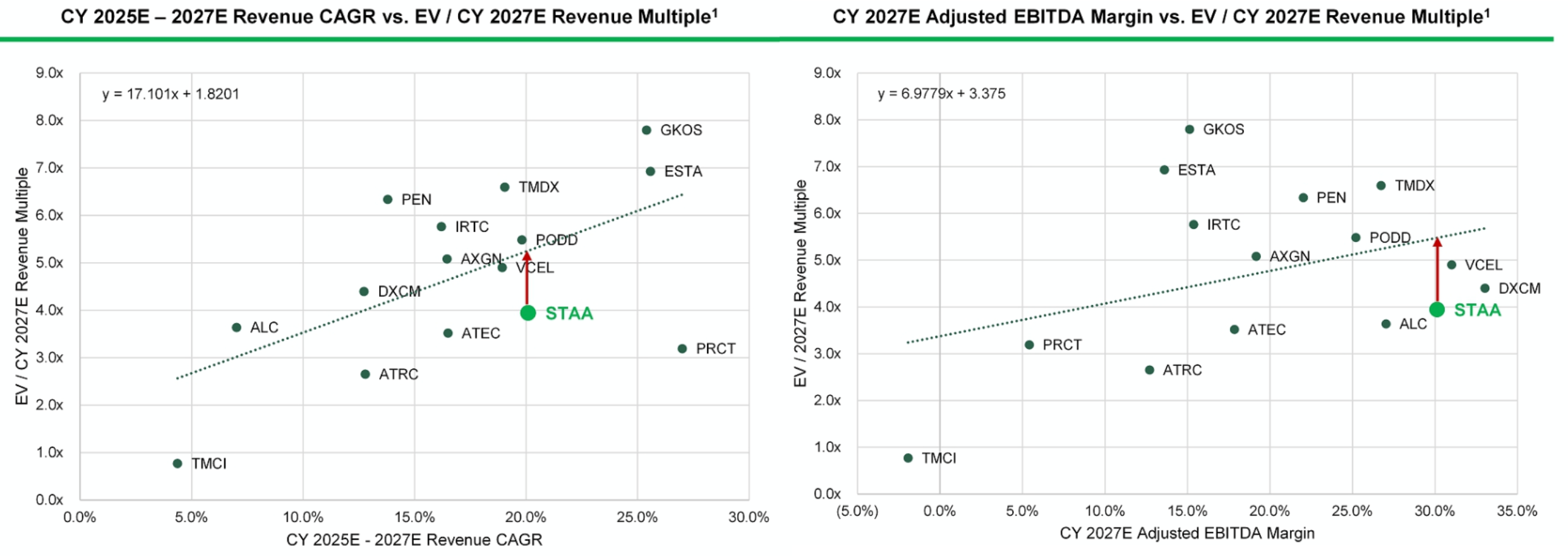
Another reference point is relative valuation. The revised Alcon offer values STAAR at 3.7x 2027E revenues. Broadwood argues that based on STAAR’s projected revenue growth and margins relative to medtech peers, the multiple should be closer to 5.3x-5.5x. That would imply a price target of $43-$45/share, with 75%+ upside from current levels. This price target is in line with STAAR’s trading levels in mid-2024, before China issues began.
The main drawback of this extended “retry the sale under Broadwood’s control” scenario is that it largely comes down to trusting the activists on STAAR’s China sales normalization.
STAA’s preliminary Q4 results should be announced in January 2026. Strong results would significantly increase the odds of reaching high-upside outcome. However, if the results disappoint, the activists’ thesis could be harmed.
As mentioned earlier, STAAR is a black box in this regard, and I can only guess what Q4 numbers will be. Still, a number of high-level signals point to a higher likelihood of positive results than negative:
- Before Alcon’s bid, management repeatedly said the China issues were temporary.
- Q2 report guided for sales normalization in H2’25.
- Performance in Q3 confirmed that guidance. See the historical performance table below.
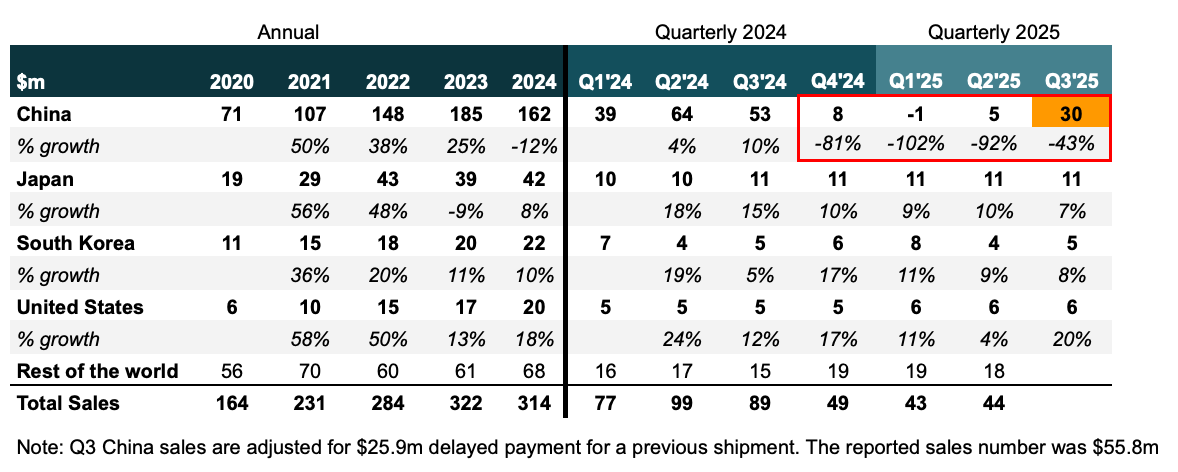
- Interestingly, STAAR’s management tried to bury the lead – Q3 preliminary figures excluded China sales entirely, and the full results barely mentioned them at all. This behavior is just super odd. If the quarter had been a one-off outlier or if previous guidance was no longer valid because the business was actually permanently impaired, they could have simply said so. Instead, it looks more like they were trying to downplay a genuine recovery that might undermine Alcon’s offer.
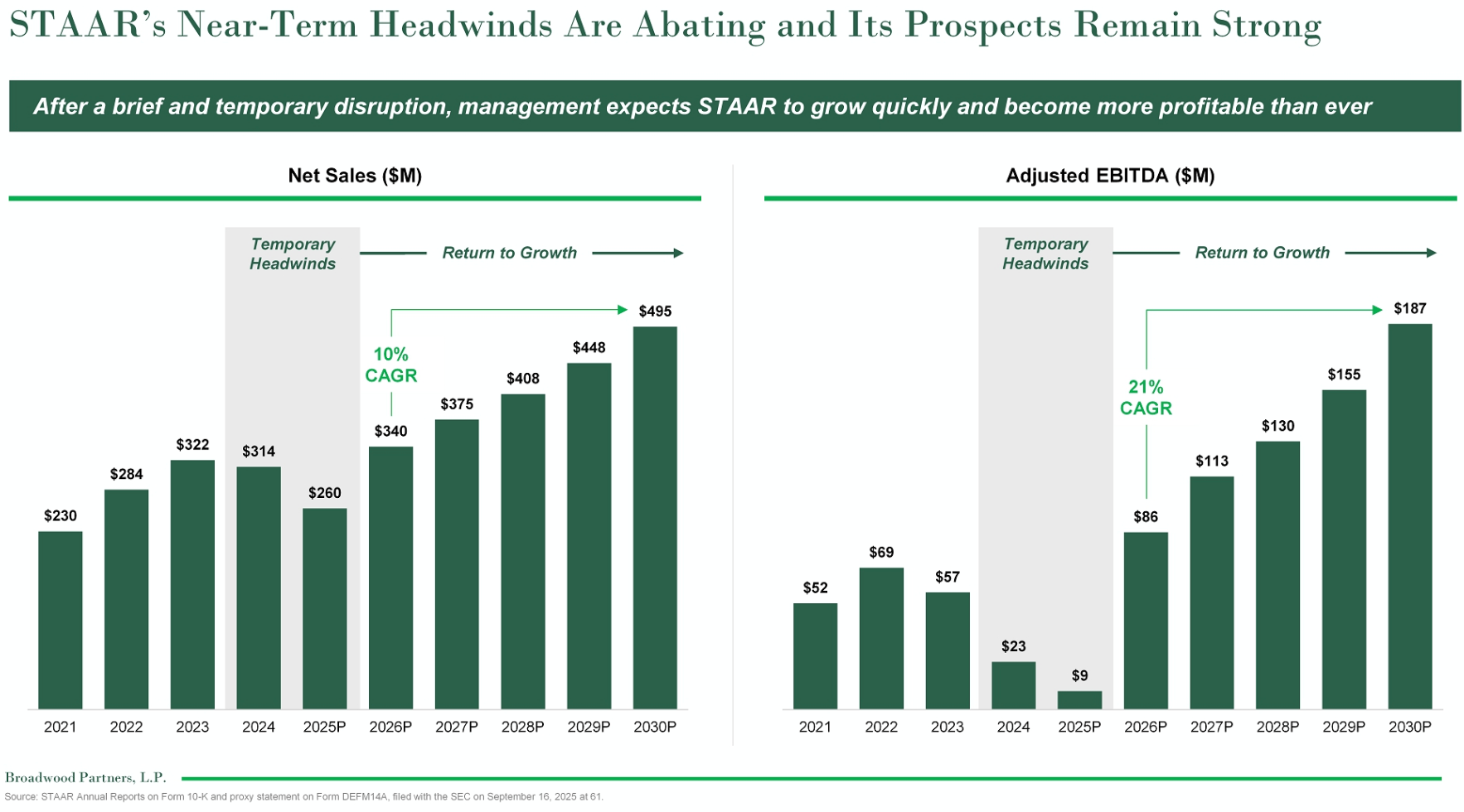
- September’s proxy included management’s financial projections that showed STAAR returning to sales and profitability growth from next year (Broadwood’s presentation):
- Broadwood seems very confident in the rebound given it increased its position in STAA by $40m last month.
- Alcon is clearly in close contact with STAAR management, and Q4 is almost over. Putting on a small tin foil hat, one could speculate that the buyer should be pretty well aware of the ongoing business trends at STAA. From this perspective, Alcon’s decision to raise the offer (and not call it final) after a failed go-shop process, could also suggest the business is going in the right direction.
So despite having zero visibility into the current situation in China, I’m comfortable enough to stand alongside the activists and betting on the rebound.
If Q4 results end up slightly disappointing (i.e. China sales are stable / in line with Q3, but full normalization will take longer than expected), the downside should remain limited, especially given the prospects of management change and activists taking control.
The numbers would need to be genuinely terrible, implying real long-term business impairment, for the share price to drop to or below pre-announcement levels. Based on everything we know so far, that appears unlikely. In the worst case, activists could simply re-engage with Alcon and try to bring it back to the table at a similar or slightly lower price.
So overall, this longer post-deal-break scenario presents an asymmetric opportunity.
Scenario #3: The current offer is approved
This is the least likely path. With 35% opposition from Broadwood and Yunqi, almost 80% of the remaining shareholders would need to approve the current offer for it to pass. Still, a small chance remains. The failed go-shop and the modest bump could give proxy firms just enough cover to issue favorable recommendations, and sway other minority holders as well.
Even if this scenario materializes, it would not be a bad result from current levels, delivering more than 20% upside in just a few weeks.
Scenario #4: The current meeting date is delayed again
This path could also expose investors to the preliminary Q4 numbers, which should arrive in January. So it also requires some confidence in the activists’ thesis of sales rebound. If the results are good, the stock will likely rally above the current offer as/and the odds of Alcon raising its bid would increase materially. That could mean a 25% to 30% return in a month, with additional upside optionality on higher offers.
If the Q4 results are released before shareholders vote on Alcon’s offer, and the numbers come in weak, activists may revise their price expectations and become more willing to support a sale to Alcon. Even in that case, the outcome would likely still yield a modest return from current levels.
Additional notes on the activists
- Broadwood Capital runs a very long-term, highly concentrated portfolio (only 12 public positions). STAAR is their third-largest holding at roughly a 22% allocation. Their track record with core positions is very strong: Monster Beverage, owned since 2009, is a 17-bagger; Axon Enterprise, held since 2017, is a 30-bagger. STAA is a 5-bagger for now.
- Yunqi Capital is a small hedge fund based in Hong Kong. STAA is their largest public position, with a 39% allocation. It’s interesting that Yunqi sold its previous stake in STAA just after the offer announcement, but then promptly reacquired the stake at ~$28/share and now holds 5.1%.
- Broadwood has also set up a website for its campaign, where more detail on its arguments can be found: www.letstaarshine.com
Closest Opex happens to be Dec 19 and these options are definitely not priced for fireworks – one way or another. Very cheap way to get in lower levels by selling puts with some juice in them, or buy cheap 25Cs for upside if Alcon shows why last offer wasn’t best and final.
Friday offered a good opportunity to achieve lower entry level via options. I created a position in my IRA so I needed to buy stock/sell calls (as opposed to simply selling puts). I sold the Dec19 $25 strikes and created the long at $22.83. I tend to believe that the meeting date will either be delayed or the vote won’t succeed if it is held.
Proxy advisor Glass Lewis is advising that shareholders reject the 30.75 bid… hence the drop on Friday
From Alcon PR Dec 9, 2025 8:30 AM Eastern Standard Time stated offer is best and final. Still these are not set in stone and a revised offer with a substantial CVR added or similar can be offered.
The amended transaction provides tremendous value to STAAR stockholders, while providing an exciting opportunity for Alcon to broaden the access to STAAR’s leading technology to benefit patients around the world,” said David Endicott, Chief Executive Officer of Alcon. “This best and final offer to the STAAR stockholders offers a clear choice: a substantial and certain premium versus an uncertain future tied to a dissident activist with a dubious track record.”
Thanks Prabhu. There’s some good evidence what happens when I don’t do proper DD…or any DD.
Thank you. I am not sure how that slipped past me. As you note, the language does not legally prevent a higher bid, even if it makes one less likely than I initially assumed.
On the positive side, Glass Lewis sided with Broadwood on essentially every major point of opposition, citing non credible management, a poorly designed go shop, and an inadequate offer price. At this stage, the offer looks doomed for rejection. So either Alcon attempts a last minute save or pushes for another delay, or the process moves into a post-break scenario. Broadwood has reiterated that it intends to call a shareholder meeting to reshuffle the board.
Glass Lewis used pretty strong language in criticizing the inadequacy of the revised offer:
https://www.bamsec.com/filing/121390025121255?cik=718937
I think there’s also a scenario 5:
Takeover is voted down and nobody wants to buy it at a higher price… Or even buy it at all.
That’s basically the worst case scenario (short of a meteor hitting Earth). It probably would only play out if China sales completely fall apart. At the end of the day, almost every scenario comes back to China sales outlook, but I agree with DT that the odds of a total bust look kinda low. Broadwood isn’t just voting the deal down, they’re effectively underwriting the standalone value and that recent $40M share purchase speaks confidence.
My base case: deal gets voted down -> stock drifts initially as arbs exit -> business recovers -> stock recovers.
Buying the common shares doesn’t seem to fit your base case very well.
Maybe buy Dec $22.5 puts for $1 and sell $25 puts further out (e.g. Dec 2026 for $3.3)?
ISS recommending shareholders vote FOR deal
https://investors.staar.com/news-and-events/press-releases/2025/12-15-2025-233507819
Two new fillings from the activists in response to ISS recommendation to vote for the merger. A couple of quotes below.
Yunqi Capital:
Broadwood: